
I've seen hundreds of pitch decks make the same fatal error. They have a "why now" slide, but it's completely useless.
Founders spend weeks perfecting their product demos and market size calculations. They nail their competitive analysis and go-to-market strategy. But they completely ignore the question every investor is silently asking:
If this is such a good idea, why hasn't someone already built it and won?
With infinite capital and talent, every startup idea has been tried before. Music streaming existed long before Spotify dominated. Video calling worked decades before Zoom became a household name. Electric cars failed for 100+ years before Tesla came along.
The difference between failed attempts and billion-dollar companies? Timing.
Why Good Ideas Fail Before Their Time
Most breakthrough companies aren't built on revolutionary ideas. They're built on evolutionary timing.
Spotify succeeded because three things converged in 2011: smartphone adoption hit critical mass, music labels were desperate after piracy killed CD sales, and cloud infrastructure made global streaming economically viable. Remove any one of these factors, and Spotify would have joined the graveyard of failed music startups.
Zoom won because the market finally aligned: WebRTC eliminated software downloads, enterprise security became table stakes, and remote work shifted from nice-to-have to necessity. The technology existed for years, but the conditions weren't right.
Tesla broke through when the conditions converged: battery costs dropped 85% between 2010-2020, charging infrastructure reached a tipping point, and government incentives made EVs cost-competitive. Electric cars had been attempted for over a century, but the ecosystem wasn't ready.
Each of these companies succeeded not because they had better ideas, but because they launched when multiple forces aligned to make success inevitable.
The Five Forces of "Why Now"
To build a compelling "why now" argument, you need to identify which forces have shifted in your favor.
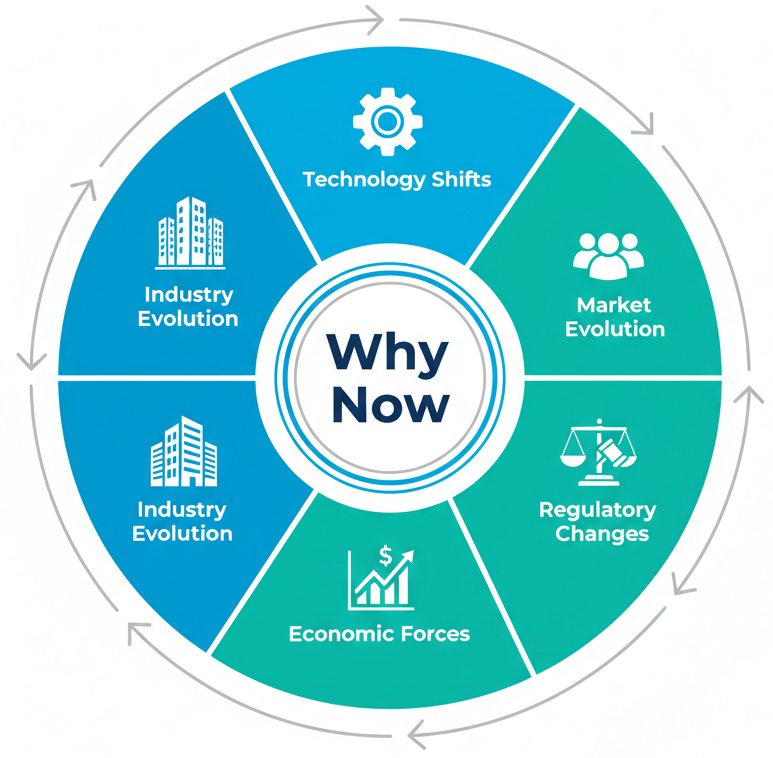
There are five categories that create timing opportunities:
Technology Shifts
New infrastructure that makes something previously impossible now feasible. These are often enabling technologies that reduce costs, increase performance, or eliminate technical barriers.
Examples include:
- API costs dropping 90%, making integration-heavy business models viable
- GPU performance improvements enabling real-time AI inference
- 5G networks making latency-sensitive mobile applications possible
Market Evolution
Changes in customer behavior, expectations, or willingness to adopt new solutions. These shifts often create new segments or expand existing markets dramatically.
Examples include:
- Remote work creating 300 million new users for collaboration tools
- Consumers becoming comfortable with subscription models across industries
- B2B buyers preferring self-serve trials over traditional sales processes
Regulatory Changes
New laws, compliance requirements, or regulatory frameworks that create opportunities or mandates. These often force entire industries to adopt new solutions.
Examples include:
- GDPR requiring every company to rebuild their data handling processes
- Open banking regulations creating fintech opportunities
- Healthcare privacy laws mandating new security infrastructure
Economic Forces
Interest rates, funding availability, or market conditions that favor certain business models. Economic cycles often determine which approaches become viable.
Examples include:
- Zero interest rates making growth-over-profit models attractive
- Supply chain disruptions creating demand for local alternatives
- Labor shortages driving automation adoption
Industry Evolution
Changes in how major players in your target industry embrace new technology or business models. This is particularly crucial in oligopolistic industries where incumbent behavior determines market adoption.
Consider the eBook revolution. In the late 1990s, the book industry was highly resistant to digital formats, partly because of what was happening with services like Napster in the music space. Major publishers feared losing control of their content and were skeptical of digital rights management solutions.
It took nearly a decade for publishers to accept DRM technologies and become comfortable making their content available electronically. Amazon's Kindle succeeded not just because the technology was ready, but because the publishing industry had finally evolved to embrace digital distribution. The same content protection technologies that existed in 1999 suddenly became acceptable in 2007.
Other examples include:
- Banks embracing cloud infrastructure after decades of on-premise requirements
- Healthcare systems adopting telemedicine after regulatory resistance
- Enterprise software buyers accepting SaaS models over perpetual licenses
How Not to Answer "Why Now"
Most founders answer this question with vagueness and hope. I see these weak arguments constantly:
- "The market is ready for disruption"
- "Customers want better solutions"
- "The timing feels right"
- "Technology has finally caught up"
These statements are meaningless because they could apply to any company at any time. They don't explain why your specific solution couldn't work before, or why it will work now.
Weak timing arguments often rely on:
- Circular reasoning: "We're building this because the time is right"
- Generic trends: "Digital transformation" or "AI adoption"
- Wishful thinking: "Customers will eventually want this"
- Competition ignorance: "No one has tried this before"
How to Build a Compelling "Why Now" Argument
A strong "why now" argument is specific, measurable, and explains both why it couldn't work before and why it will work now. Here's how to construct one:
Start with the Failure Analysis
Identify previous attempts in your space and explain specifically why they failed. This shows you understand the challenges and aren't naive about the difficulties.
For example: "Video conferencing companies like WebEx existed for decades but required software downloads, had poor mobile experiences, and couldn't handle enterprise security requirements."
Identify the Specific Shifts
Pinpoint exactly which forces have changed and provide concrete evidence. Use data, not opinions.
Good examples:
- "API integration costs dropped from $50,000 to $5,000, making our unit economics work at SMB scale"
- "Remote work policies increased our addressable market from 50 million to 350 million knowledge workers"
- "New SOC2 requirements mandate the data governance features that were previously nice-to-have"
Connect the Dots
Explain how these shifts specifically enable your solution. Don't assume the connection is obvious.
For instance: "Because WebRTC eliminated downloads, enterprise security became standardized, and remote work became mandatory, video conferencing could finally become as simple as clicking a link while meeting enterprise requirements."
Quantify the Opportunity
Show how these timing factors create measurable market expansion or cost reduction.
Examples:
- "This created a $10B market that didn't exist five years ago"
- "Our customer acquisition cost dropped 60% because buyers now actively seek our solution"
- "Implementation time decreased from 18 months to 6 weeks due to new infrastructure"
The Timing Test
Before you finalize your "why now" argument, apply this test:
- Could this have worked five years ago? If yes, explain why no one succeeded
- Will this work five years from now? If the window is closing, explain the urgency
- What evidence proves the shift? Provide specific data points, not general trends
- How do you know incumbents can't adapt? Explain their structural disadvantages
Making Skeptics into Believers
The best "why now" arguments don't just explain timing—they make it feel inevitable. When done right, your audience should think "Of course this will work now" rather than "I hope this works."
Next time you pitch, whether to an investor, a recruit, or a customer:
- Explain specifically why it couldn't have worked five years ago
- Identify exactly which forces have shifted in your favor
- Quantify how these changes enable your business model
- Connect the timing to your competitive advantages
Remember: investors don't fund good ideas. They fund good ideas at the right time.
That's how you turn a skeptic into a believer.
Putting It Into Practice
Your "why now" slide shouldn't be an afterthought—it should be the foundation of your entire pitch. Because if you can't convincingly answer why now, you probably shouldn't be building it now.