
I've watched brilliant new hires crash and burn not because they lacked talent, but because they made one fatal mistake. They rushed to prove their worth instead of learning the product they were hired to improve.
This happens everywhere. Sales reps who stumble through demos because they've never actually used the product. Marketing managers creating campaigns for features they don't understand. Product managers building roadmaps without experiencing user pain points firsthand. Engineers shipping code for workflows they've never seen in action.
The pattern is always the same: new employee joins with energy and ambition, wants to prove their worth immediately, dives straight into their job function, treats product learning as secondary. Weeks pass. Work gets busier. The window to learn the product closes. They spend months working on something they don't truly understand.
Companies make this worse by pressuring new hires to deliver results in days, not months. 30-60-90 day plans become 3-6-9 day sprints. Learning time feels like a luxury they can't afford.
But here's what I've discovered: when people learn the product first, everything else becomes dramatically easier.
The Hidden Cost of Product Ignorance
Across multiple startups I've worked with and observed, I've seen this pattern repeatedly.
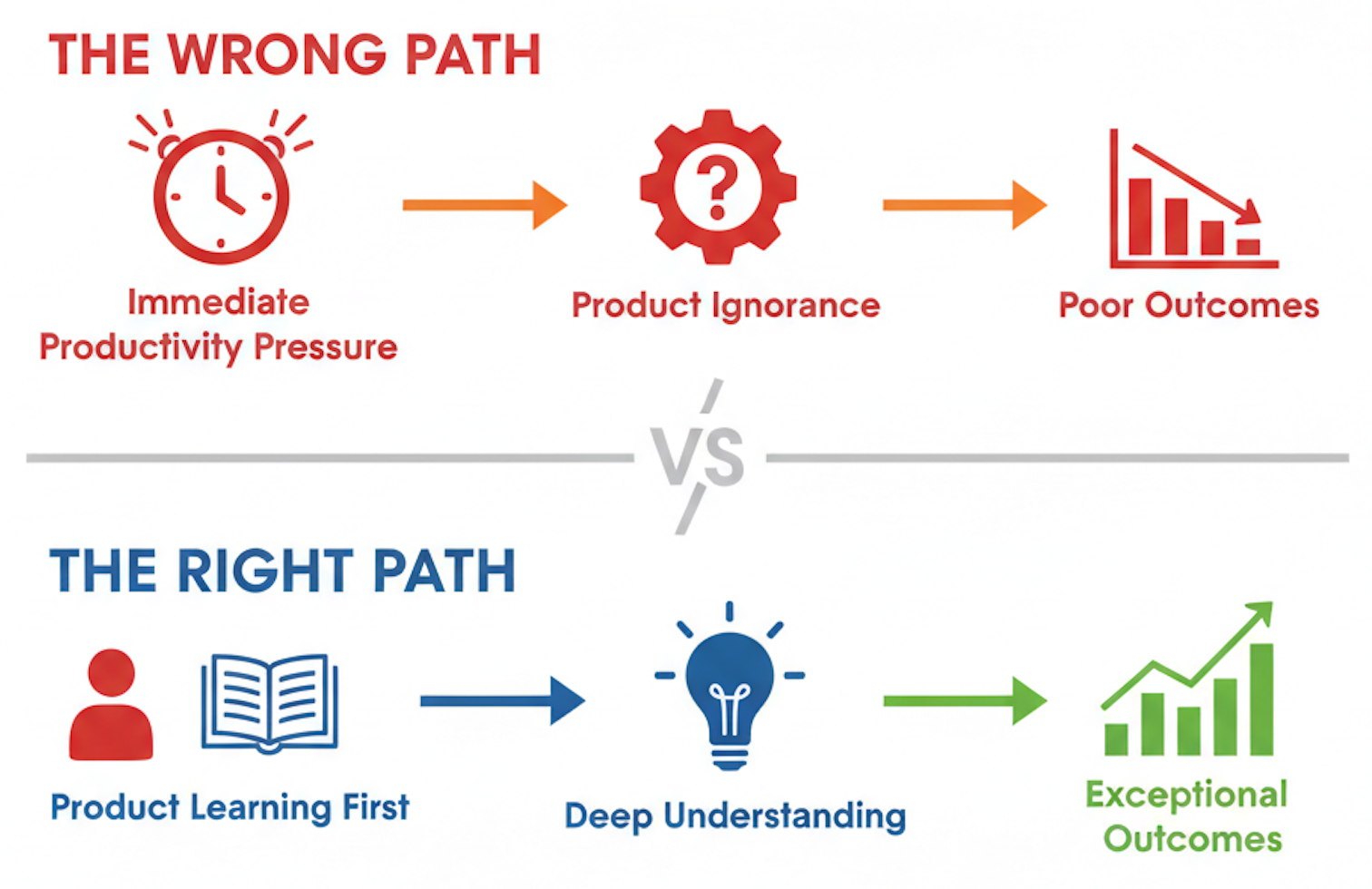
The symptoms appear everywhere:
Sales demos become painful. Reps stick to scripted paths because they don't understand the underlying workflows. When prospects ask "what if" questions, they deflect with "let me get back to you on that." Deal cycles stretch because reps can't confidently address real use cases.
Marketing messages fall flat. Campaigns highlight features that sound impressive but don't solve actual customer problems. Teams create content about capabilities that look good on paper but miss the emotional triggers that drive conversions.
Customer success becomes reactive. Support tickets reveal gaps between what customers expected and what the product actually delivers. Teams spend time explaining limitations instead of driving adoption.
Product decisions suffer. Roadmap discussions become abstract debates about features rather than informed conversations about user experience. Companies build what sounds logical instead of what users actually need.
The breaking point often comes when renewal rates drop or deal cycles stretch. Leadership asks simple questions: "Do our own employees use the product the way our customers do?" The answer is usually uncomfortable.
The Product-First Transformation
When teams become product-first, the results are consistently transformational:
Sales demos become effortless. Reps can speak confidently about real use cases because they've lived them. They anticipate customer questions because they've had the same questions. Deal cycles often shorten by 20-30% because conversations become consultative rather than presentational.
Marketing messages resonate. Campaigns speak to actual pain points because marketers have felt the pain. I've seen click-through rates improve 30-40% when messaging shifts from feature-focused to outcome-focused language.
Customer success becomes proactive. Support tickets often decrease by 20-25% because onboarding and training improve. Teams can guide customers toward success patterns they've personally experienced.
Product decisions get better. Roadmap discussions include real user context. Features ship faster because requirements are clearer. Customer feedback shapes development because teams understand customer language.
Most importantly, new hires began generating product improvements that helped everyone. They identified workflow inefficiencies that long-term employees had learned to work around. They questioned assumptions that teams had stopped examining.
Implementation Without Disruption
The biggest objection I hear is "we can't afford to have new hires unproductive for a week." This thinking is backwards. You can't afford to have employees working on products they don't understand for months.
Here's how to implement product-first onboarding without disrupting productivity:
Start Small
Begin with one role or one team. Sales is often the easiest starting point because the connection between product knowledge and performance is most obvious.
Create Structure
Develop specific scenarios and tasks rather than saying "explore the product." Give new hires concrete objectives and success criteria.
Pair Learning with Work
Instead of pure exploration time, have new hires complete real work using the product. Marketing can create actual campaigns, sales can prepare for real demos, product can document actual requirements.
Capture Insights
New hire perspectives are valuable. Create systems to capture and act on their observations before they become blind to what now seems "normal."
Measure Impact
Track metrics that matter: time to productivity, customer satisfaction scores, feature adoption rates, and renewal rates. Product-first onboarding will improve all of these.
The Competitive Advantage Hidden in Plain Sight
Most companies treat product knowledge as something employees will pick up over time. This creates a massive opportunity for companies willing to invest upfront in deep product education.
Consider the compound effects:
Better Customer Conversations: Every customer-facing employee becomes more credible and helpful
Faster Feature Adoption: Internal teams can better guide customers toward valuable features
Improved Product Development: Requirements become clearer when the team understands user context
Reduced Support Burden: Better initial implementations and training reduce ongoing support needs
Higher Renewal Rates: Customers succeed more often when guided by teams who understand their workflows
I've consistently seen companies improve renewal rates by implementing product-first onboarding. While not exclusively due to better product knowledge, it becomes the foundation that makes every other improvement possible.
Beyond the First Week
Product-first onboarding is the beginning of a cultural shift toward product-centricity, rather than just a one-time event. Here's how to maintain momentum:
Regular Product Updates
When features change, ensure all teams understand the implications. Product announcements should include guidance for every role.
Customer Feedback Loops
Create systems for teams to share customer insights back to product development. Sales team feature requests become more valuable when they understand technical constraints.
Cross-Functional Projects
Regularly assign projects that require different teams to collaborate using the product. This maintains hands-on familiarity and reveals optimization opportunities.
Competitive Analysis
Periodically have teams explore competitive products to maintain context for differentiation and identify improvement opportunities.
The Choice
Every company faces the same decision: rush new hires into productivity or invest in deep product understanding first. Most choose the former because it feels urgent. The best companies choose the latter because it compounds.
Your newest employees bring fresh perspectives and energy. They're motivated to contribute and eager to learn. This window of opportunity closes quickly as they get busy with day-to-day responsibilities and learn to work around product limitations rather than question them.
The companies that consistently outperform their competitors understand something fundamental: employees who deeply understand the product they're improving, selling, marketing, or supporting will always outperform those who don't.
That understanding starts with giving them time to actually learn it.
What if your next hire spent their first week becoming a power user instead of sitting through presentations about what the product does? What if they experienced your customer's journey before trying to improve it?
That's how you turn good employees into great ones.
And that's how you build a team that truly understands what they're building.