Most founders think being essential to workflows equals defensibility. They're dangerously wrong.
I've watched countless "essential" products get displaced by inferior alternatives. Slack was integral to millions of teams' daily communication yet Microsoft Teams still ate their market share. Zoom became the go-to video platform during the pandemic yet Google Meet and Microsoft Teams kept gaining ground anyway.
The harsh reality? Being integral is just table stakes in today's market. Real defensibility comes from lock-ins that are impossible to replicate, and most founders are building the wrong kind.
In this post, I'll share the framework that separates sustainable competitive advantages from temporary workflow dependencies, and how the best companies create lock-ins that customers never want to escape.
The Essential Product Trap
Most SaaS founders fall into what I call the "essential product trap." They believe that if customers use their product daily, depend on it for critical workflows, and would be disrupted without it, they've built an unshakeable competitive moat.
This thinking is more than just wrong… it's dangerous.
Slack seemed untouchable in 2019. The company had achieved the holy grail of product-market fit: millions of teams couldn't imagine work without it. Daily active users were through the roof. Customer satisfaction scores were stellar. The product was genuinely essential to how modern teams communicated.
Then Microsoft bundled Teams with Office 365, and everything changed.
It wasn't that Teams was better. In fact, most users agreed Slack had superior features and user experience. But Microsoft understood something Slack didn't: being essential to workflows isn't the same as being impossible to replace.
Zoom tells a similar story. During the pandemic, Zoom became synonymous with video conferencing. The company's growth was astronomical, and their product was literally essential for remote work to function. Yet Google Meet and Microsoft Teams continued gaining market share throughout Zoom's moment of peak dominance.
Why? Because workflow dependency creates temporary stickiness, not permanent defensibility.
The Lock-In Spectrum
Real defensibility comes from lock-ins that make switching not just inconvenient, but genuinely costly or impossible. But not all lock-ins are created equal. The best ones create increasing value while they protect market position. The worst ones create friction while they trap customers.
Understanding this distinction is crucial because customers will eventually break free from friction-based lock-ins, but they'll never want to leave value-based ones.
Value-Based Lock-Ins: The Defensible Choice
The most powerful lock-ins don't feel like locks at all. Instead, they create genuine value that increases over time, making customers more successful while simultaneously making switching less attractive.
Data Lock-Ins: The Compound Interest of Software
The best data lock-ins give users better insights, predictions, and outcomes as they accumulate more information in the system. Each additional data point makes the product more valuable, creating a compound effect that's impossible to replicate quickly.
Salesforce exemplifies this approach. The longer a sales team uses Salesforce, the better the system becomes at predicting deal outcomes, identifying successful patterns, and providing actionable insights. Years of historical data create predictive models that a competitor simply cannot match on day one.
HubSpot's marketing automation works similarly. The platform learns from every email campaign, every lead interaction, and every conversion event. This accumulated intelligence powers better segmentation, more effective campaigns, and higher conversion rates. Switching to a competitor means abandoning years of learned optimizations.
The key insight: these companies do store data, but more importantly because of the data, their product value compounds over time.
Network Effects: Value That Scales with Users
Network effects create defensibility by making the product exponentially more valuable with each new user. The mathematics of network effects are brutal for competitors: by the time a network reaches critical mass, the switching cost is insurmountable.
LinkedIn demonstrates this perfectly. The platform becomes more valuable for every user as more professionals join. A competing professional network might offer better features, but it can't offer access to the same network of connections. Users are locked in both by their own data, but also by everyone else's participation.
Slack actually had network effects within individual teams, but Microsoft Teams exploited a larger network effect: integration with the entire Microsoft ecosystem that most enterprises already used.
Zoom missed this opportunity entirely. Despite their superior video quality and user experience, they never built meaningful network effects. Every call was essentially independent, creating no cumulative value from continued usage.
Deep Integration Lock-Ins: Becoming the Nervous System
The most powerful lock-ins transform from tools into infrastructure. These deep integrations become so embedded in customers' technology stacks that removing them would require rebuilding entire systems.
Stripe exemplifies this approach. While payment processing might seem like a commodity, Stripe has built deep integrations that touch every aspect of a company's financial operations: subscription billing, marketplace payments, fraud detection, accounting integration, and revenue recognition. Switching payment processors becomes equivalent to rewiring a company's entire financial infrastructure.
Twilio follows a similar strategy in communications. At one level, Twilio could be seen as an API to simply send messages. But they have lock-in because, they become embedded in customer authentication flows, notification systems, and core product features. Replacing Twilio means rebuilding fundamental application functionality.
AWS achieved the ultimate integration lock-in by becoming the foundation that other software runs on. Companies architect entire systems around AWS capabilities, making migration extraordinarily complex and expensive.
Friction-Based Lock-Ins: The Losing Strategy
While value-based lock-ins create genuine customer success, friction-based lock-ins rely on pain, inconvenience, and penalties to prevent switching. These approaches might work in the short term, but they fundamentally misalign company incentives with customer success.
Contract Penalties: The Hostage Strategy
Some companies try to create defensibility through contractual obligations: long-term contracts with early termination fees, minimum usage commitments, or complex cancellation processes. While these tactics can temporarily prevent churn, they create adversarial relationships with customers.
The problem with contract penalties is that they protect companies from their own mediocrity. Instead of investing in product improvements or customer value creation, companies rely on legal obligations to maintain revenue. This approach inevitably backfires as customers become increasingly resentful and actively seek alternatives.
Moreover, contract penalties only work until competitors offer sufficient incentives to overcome the switching costs. When Microsoft bundled Teams "for free" with Office 365, many companies gladly paid Slack cancellation fees to switch.
Implementation Hell: Complexity as a Moat
Another common friction-based approach involves creating intentionally complex implementation and onboarding processes. The theory is that if switching requires months of work, customers will stick with inferior solutions rather than endure the migration pain.
Traditional enterprise software companies perfected this strategy: complex installations, extensive customizations, lengthy training programs, and consultant-dependent deployments. The larger switching cost is not the price of the software, but rather the organizational disruption of changing systems.
But this approach has become increasingly ineffective as modern software emphasizes ease of implementation. Cloud-native solutions, better APIs, and improved data migration tools have dramatically reduced switching friction. Companies that relied on implementation complexity for defensibility find themselves vulnerable to more agile competitors.
Proprietary Formats: Data Hostage Taking
Perhaps the most customer-hostile lock-in strategy involves using proprietary data formats that make export difficult or impossible. These companies essentially hold customer data hostage, betting that the pain of recreating years of information will prevent switching.
This approach fails for multiple reasons. First, it creates deep customer resentment that motivates them to find alternatives. Second, regulatory pressure increasingly requires data portability. Third, modern data migration tools and services have made even complex data transitions manageable.
Worst of all, proprietary format lock-ins signal to customers that the company lacks confidence in their product's actual value. If the software were genuinely superior, why would artificial switching barriers be necessary?
The Defensibility Framework
To build sustainable competitive advantages, founders need a systematic approach to evaluating and building lock-ins.
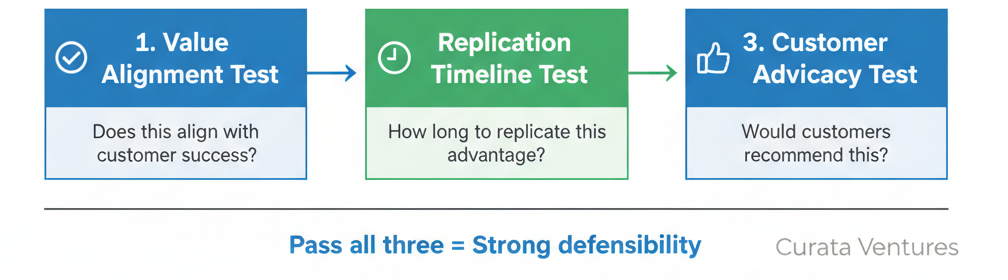
Here's the framework I use to assess defensibility strategies:
The Value Alignment Test
The first question to ask about any potential lock-in: Does this strategy align with or oppose customer success?
Value-based lock-ins pass this test easily. Salesforce's data intelligence makes customers more successful at sales. LinkedIn's network effects help users advance their careers. Stripe's deep integrations enable companies to build better products.
Friction-based lock-ins fail this test.
Contract penalties don't make customers more successful. Instead, they just make them trapped.
Complex implementations don't improve outcomes. Instead, they create organizational pain.
Proprietary formats don't add value. Instead, they reduce customer autonomy.
The Replication Timeline Test
The second question: How long would it take a well-funded competitor to replicate this advantage?
Data lock-ins with compound value are nearly impossible to replicate quickly. A new CRM can't instantly provide years of predictive intelligence. A new professional network can't immediately offer the same connection opportunities.
Network effects become stronger over time, making replication increasingly difficult. Integration lock-ins require rebuilding customer infrastructure, creating significant time and cost barriers.
Friction-based lock-ins, ironically, are often the easiest to replicate. Competitors can offer better contract terms, simpler implementations, and standard data formats. The "advantage" disappears as soon as someone offers a superior alternative.
The Customer Advocacy Test
The final question: Would customers recommend your lock-in strategy to their peers?
Customers enthusiastically recommend products with value-based lock-ins. Sales teams praise Salesforce's intelligence capabilities. Developers advocate for Stripe's integration ease. Professionals refer colleagues to LinkedIn.
No customer recommends products because of their cancellation fees, complex implementations, or proprietary data formats. These friction-based approaches generate complaints, not advocacy.
Building Your Defensibility Strategy
Creating sustainable competitive advantages requires intentional design from the earliest product decisions. Here's how to build value-based lock-ins into your product strategy:
Start with Data Intelligence
Every SaaS product generates data, but few transform that data into compound value. Look for opportunities to:
- Use historical data to improve future predictions or recommendations
- Identify patterns that become more accurate with larger datasets
- Create personalized experiences that improve over time
- Build benchmarking capabilities that require industry-wide data
The key is ensuring that data value compounds rather than just accumulates. Raw data storage itself doesn't provide a lock-in, but data intelligence does.
Design for Network Effects
Network effects require deliberate product design. Consider how to:
- Create value that increases with each additional user
- Build features that require coordination between multiple users
- Enable users to invite and benefit from colleagues or partners
- Develop marketplace dynamics where supply and demand reinforce each other
Remember that network effects within individual customers (like Slack's team networks) are weaker than network effects across customers (like LinkedIn's professional network).
Plan Integration Depth
Surface-level integrations are easily replaceable, but deep integrations become infrastructure. Focus on:
- Embedding your product in customer workflows rather than just connecting to them
- Building features that other systems depend on, not just consume
- Creating APIs that become critical to customer product functionality
- Developing capabilities that would require significant engineering effort to replace
The goal is becoming essential to how customers build and operate their businesses, not just how they complete specific tasks.
Avoid the Friction Trap
Resist the temptation to build defensibility through customer friction. This means:
- Offering flexible contract terms that demonstrate product confidence
- Designing simple implementations and smooth onboarding experiences
- Using standard data formats and providing easy export capabilities
- Competing on value creation rather than switching prevention
Customers notice when companies prioritize their own lock-in over customer success. This resentment eventually motivates them to find alternatives.
The Long-Term View
Building sustainable defensibility requires patience and conviction. Value-based lock-ins take time to develop their full protective power, while friction-based alternatives can provide immediate (but temporary) customer retention.
The companies that build lasting competitive advantages understand that real defensibility comes from making customers more successful, not more trapped. They invest in compound data value, network effects, and deep integrations because these strategies align company success with customer success.
Most importantly, they recognize that being essential to workflows is just the beginning. The ultimate goal to become irreplaceable.
The Choice
Every product decision is a choice between building value-based defensibility or relying on friction-based retention. The companies that consistently choose value creation build competitive moats that competitors can't replicate. The companies that choose friction creation build temporary barriers that customers eventually overcome.
Slack chose to focus on being essential to daily workflows. Microsoft chose to build deeper integration lock-ins with their broader ecosystem. The market has delivered its verdict on which strategy creates more sustainable defensibility.
Zoom chose to optimize for individual call quality. Google and Microsoft chose to embed video conferencing into larger productivity suites. Again, the market has shown which approach creates stronger competitive advantages.
The lesson is that being essential to workflows is worthless in the long run on its own accord. Workflow dependency without deeper lock-ins creates vulnerability. The most successful companies combine both: they become essential to daily operations AND impossible to replace through accumulated value.
That's how you turn customer dependency into competitive defensibility.
And that's how you build a business that customers never want to leave.