
At one point, my SaaS marketing technology company, Curata, experienced the highest levels of churn in the history of the business. In one particular quarter, we only renewed 40% of available dollars, equating to a 60% churn rate. Within the next nine months, we methodically doubled our renewal rates, which required dramatic changes in process, technology and mindset by providing "critical care".
Revenue Builders podcast interview covering this framework by John McMahon (5x CRO & MongoDB, Snowflake & Sprinklr board member)
The changes that we made are not unique to my company and can easily be replicated to most other B2B SaaS businesses. In this post, I'll share with you what we did, the framework that I developed for this, and how you can implement this yourself.
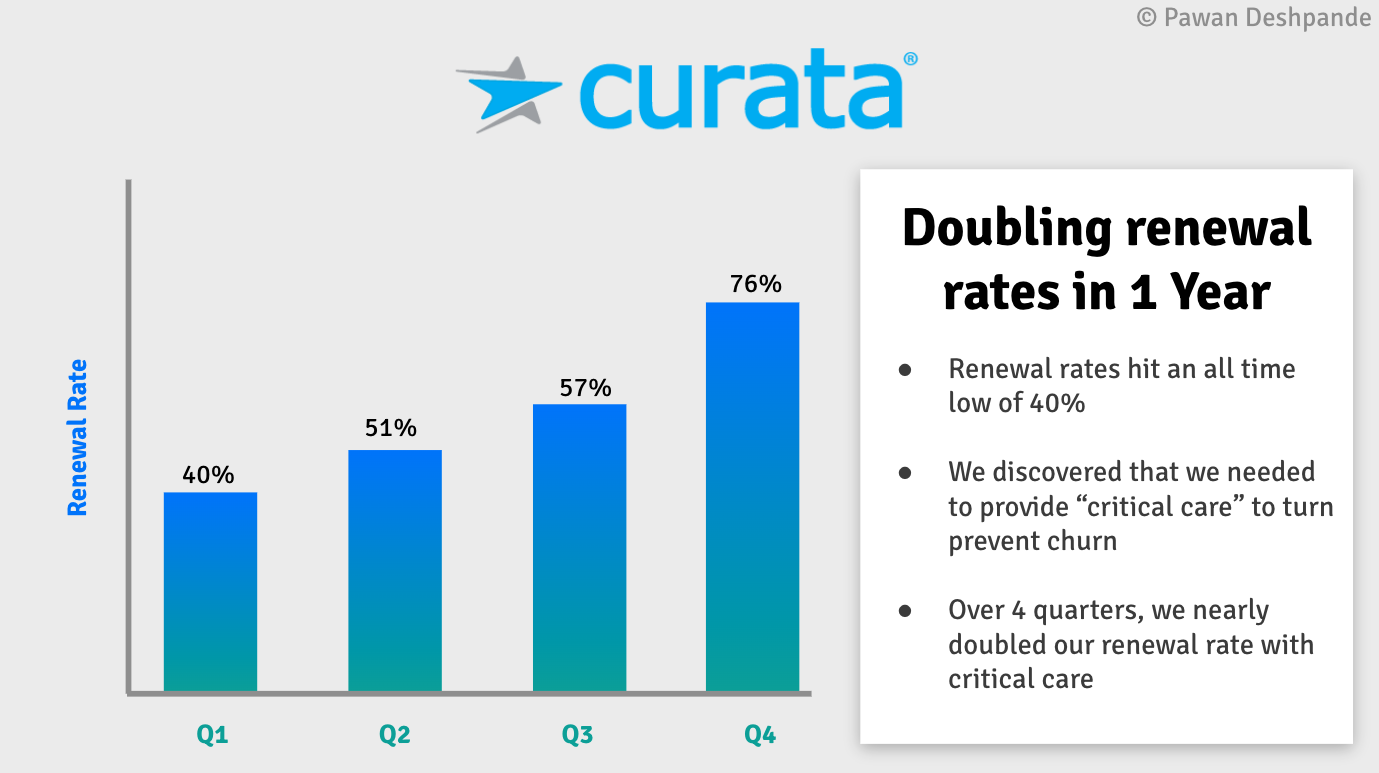
Most companies today still do not provide critical care for customers though it's probably the single most effective way of combating churn after ensuring that:
- Your product is capable of delivering on customer needs
- Your sales team is not overselling
What is Critical Care?
So what is critical care? To better understand this, let's examine the four means of providing customer success.
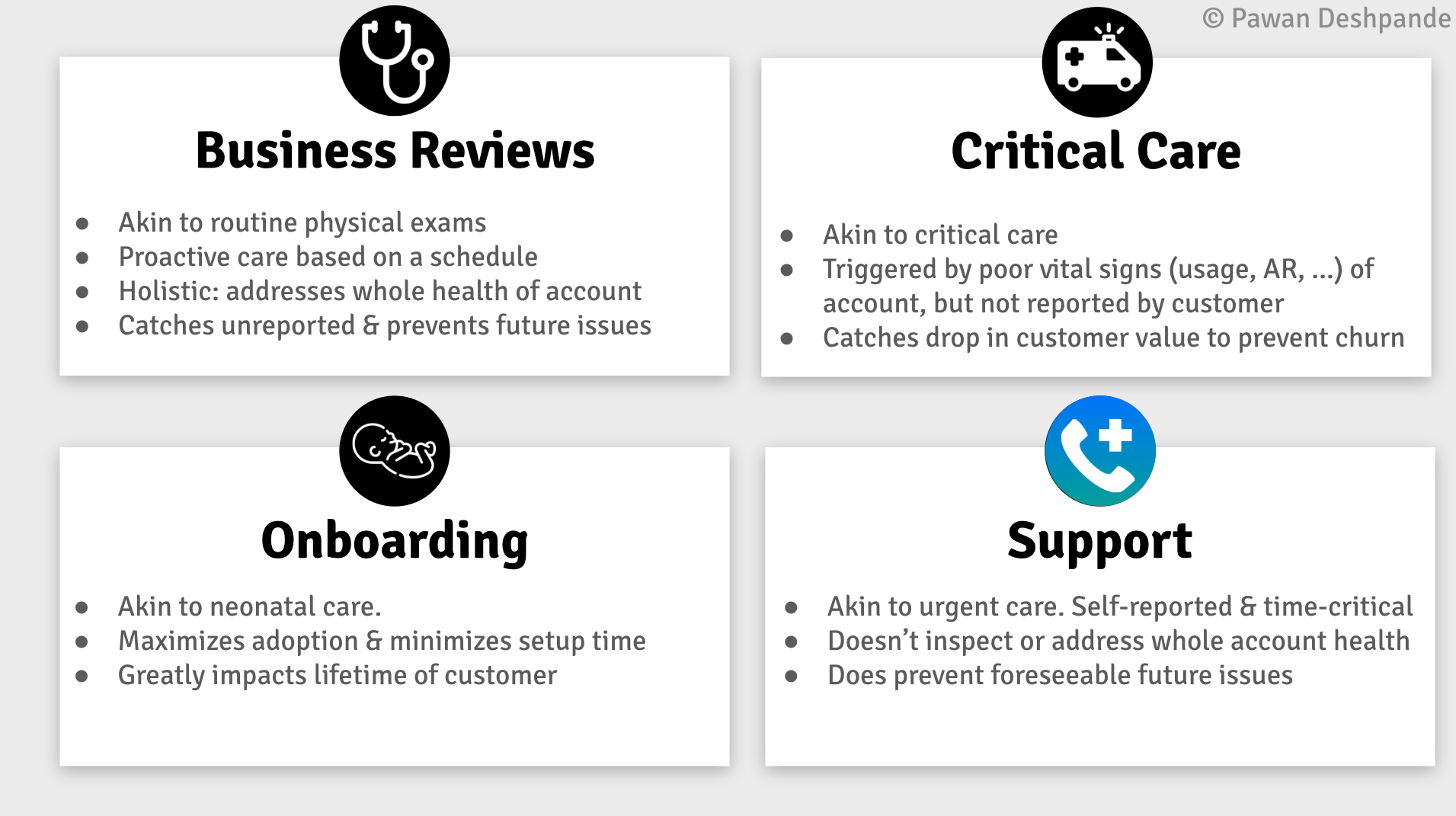
I often like to use the analogy of medical care to explain these four means of customer success:
- Customer Support which is akin to Urgent Care
- Onboarding which is akin to Neonatal Care
- Executive Business Reviews which is akin to Routine Checkups
- What I'm calling "Critical Care".
Below we'll dive into each of these, and when they are appropriate.
Business Reviews
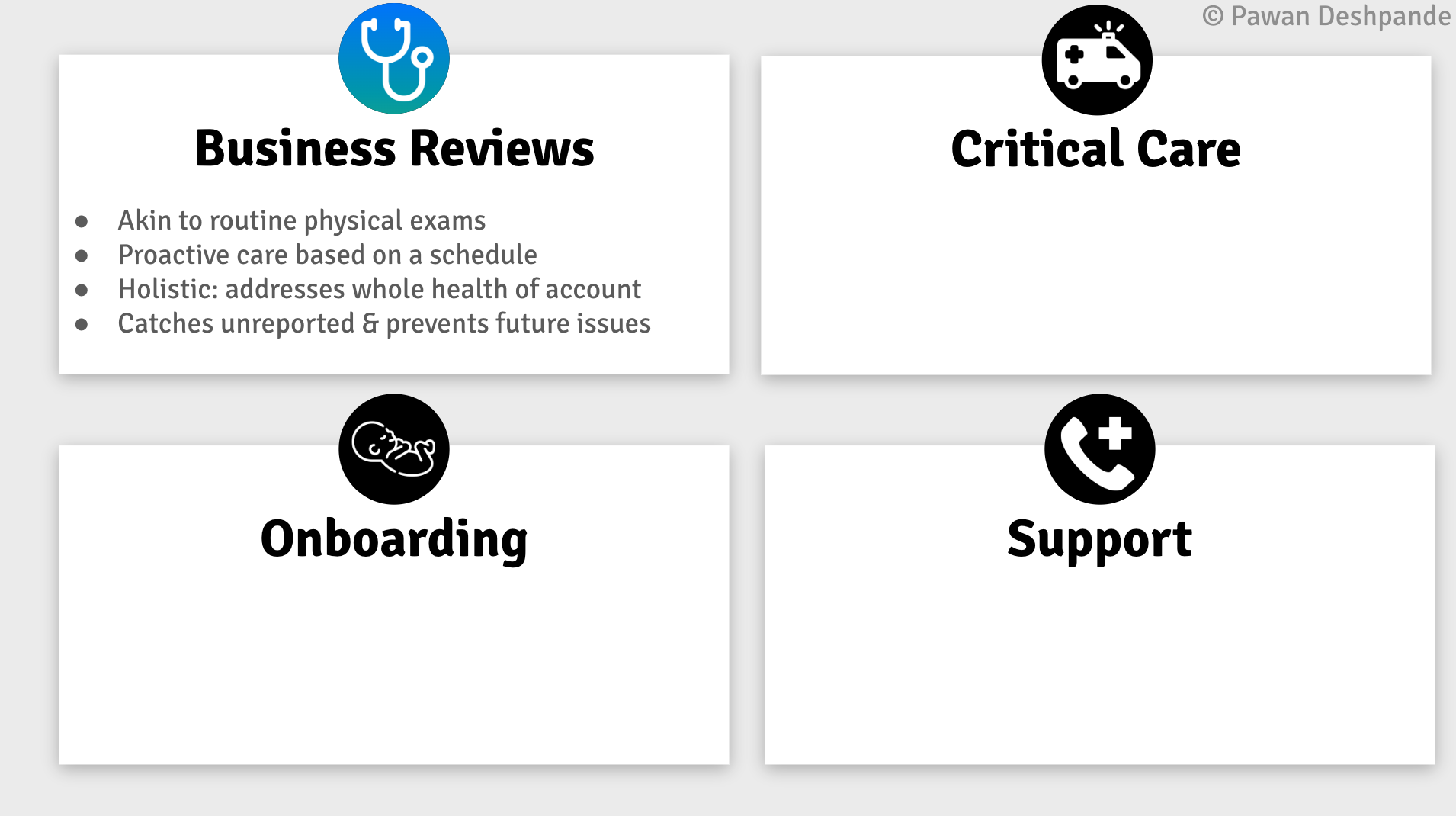
Routine care through Business Reviews or sometimes known as Quarterly Business Reviews (QBRs) or Executive Business Reviews (EBRs) are a proactive means of preventing many issues. Under this approach, a customer success manager conducts scheduled and periodic review meetings that brings together all stakeholders in the customer organization including the day-to-day user, the champion, and the sponsor to review the customer's account and proactively probe for and address foreseeable issues.
In the medical world, this is akin to routine physical check ups conducted by a primary care physician. They are conducted not in reaction to a specific issue, though they provide a forum for reporting, detecting, and addressing issues. Furthermore, a physical is holistic in that a care provider is probing for issues in all areas of the body — much like a customer success manager is attempting to ascertain issues from all stakeholders in the organization.
Routine care can detect and address many issues that arise. But it still falls short in the case of customers who either require attention between such routine meetings but do not self-report these issues. And it completely misses customers who refuse to participate in the routine care process altogether — similar to a bad patient who refuses to see the doctor. To address this, the doctor needs to go to them which we will cover next.
Critical Care
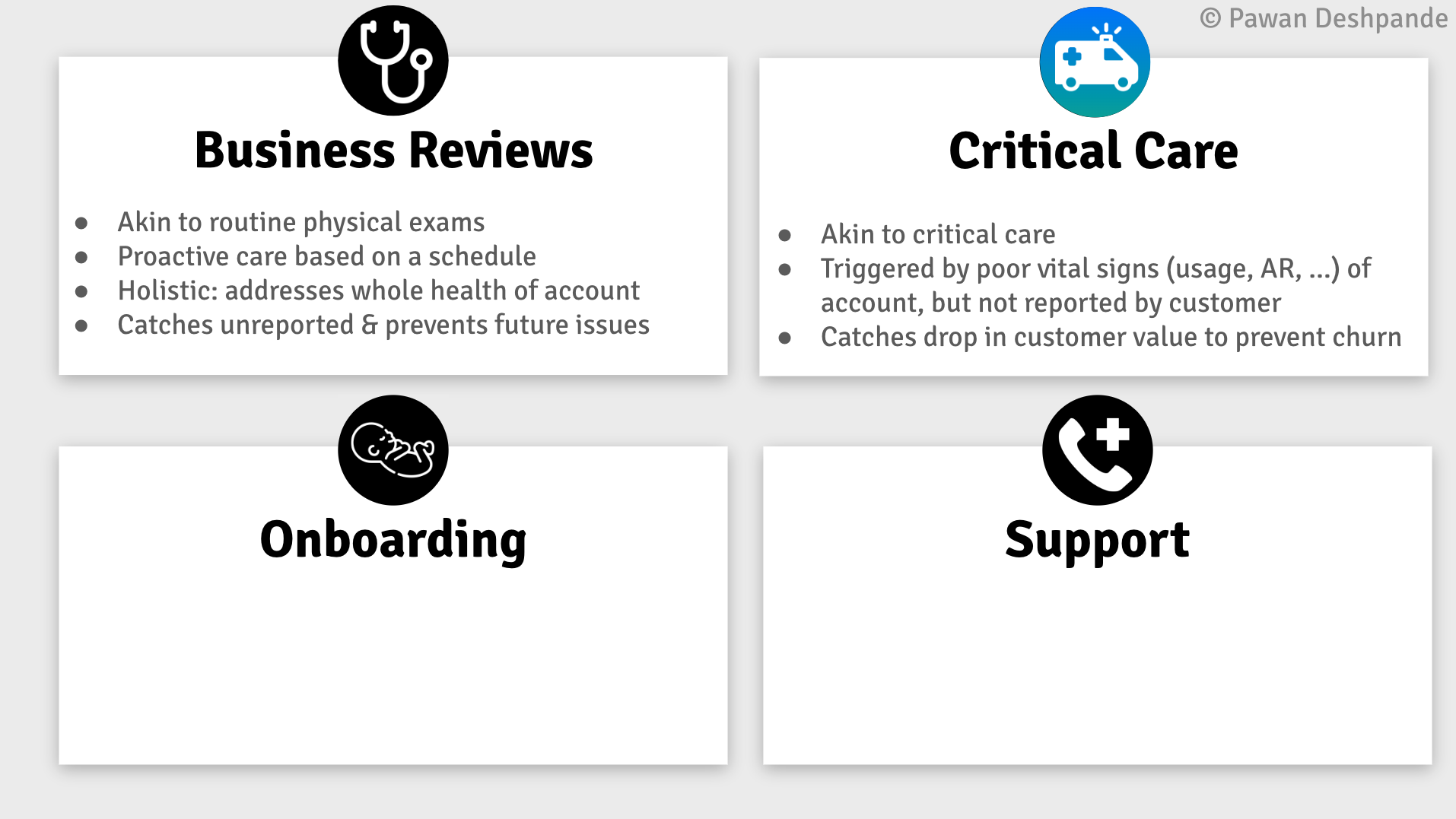
Critical care is the most advanced form of customer success that few organizations have truly mastered. In critical care, the onus is on the customer success team to proactively detect issues with a customer, and then urgently and immediately provide care to learn the underlying causes and address them.
With the medical analogy in mind, this is similar to having remote diagnostic monitors on a patient. When there is an anomaly in any vital signs on the patient as an aberrant heartbeat, the hospital then proactively may call the patient. If the patient is unresponsive to the calls, they may dispatch an ambulance to visit the patient. If the patient does not open the door, the EMTs may get creative and find a way in, perhaps go in through an open window.
Returning to the world of SaaS, critical care requires instrumentation to detect if a customer is exhibiting aberrant behavior indicative of a customer at risk of churn. These vital signs are specific to each SaaS business, but the generalizable ones that we used were:
- Drop or no recent product usage
- Broken integrations between our product and their systems
- Champion left the organization
- New users created in product
- Acquisition of customer's company
- Change in use case
- Overdue payments
When a customer exhibited any of these behaviors, our customer success team was responsible for proactively getting in touch with the customer, oftentimes before the customer themselves knew they had a problem.
Neonatal Care / Onboarding
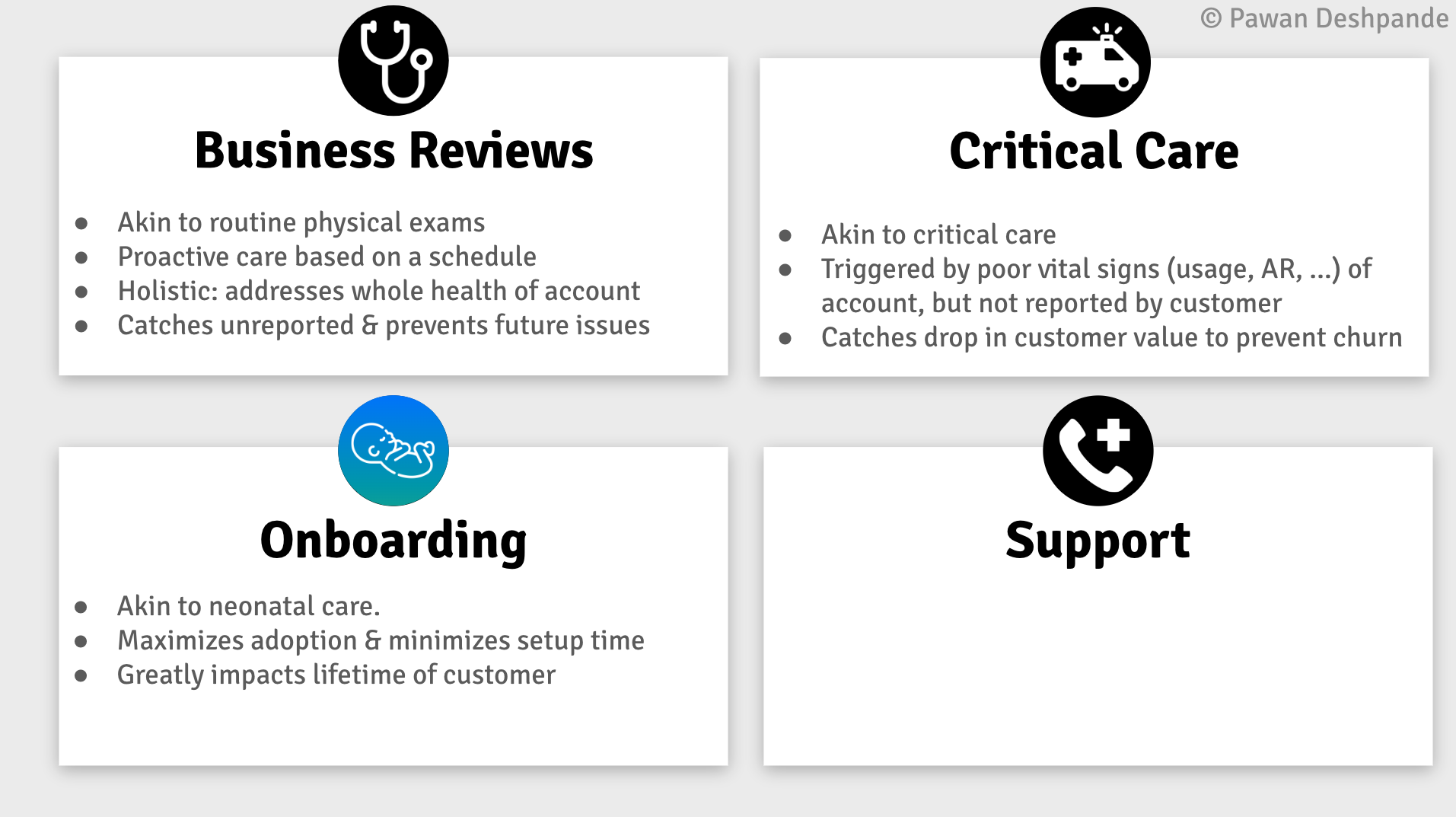
This means of customer success is typically found in either on-premise or SaaS enterprise products is what I call as neonatal care. The goal here to get the customer to fully adopt the technology in the shortest time possible. Many teams will have a dedicated sub-team focussed on this type of support as it requires a specialized process, and a heavy upfront investment.
Just like neonatal care in a hospital setting, how it is provided can greatly impact the customer / patient for better or for worse for the rest of their lifetime — and in some cases even determine the length of that lifetime, be it for an infant or a software subscription.
Having a strong onboarding program coupled with reactionary support is still insufficient. Even if a customer is off to a great start, and is able to resolve self-reported issues, churn can still creep in. To address that, there are two more types of customer success that need to be provided.
Urgent Care / Customer Support
The most basic means of providing customer success is that nearly every company provides simply reactionary customer support. When a customer has an issue, they contact the company, and the company reactively attempts to address the issue. This is similar to an urgent care clinic, where a patient visits only when they have a self-reported time-critical issue.
While it's necessary to provide this means of reactionary customer support, for SaaS and other subscription businesses that require a customer to renew, this is not sufficient. Reactionary care has two major shortcomings: First, it does not inspect or address the health of the customer/patient as a whole, nor it does attempt to prevent foreseeable issues that may occur.
Outbound vs Inbound
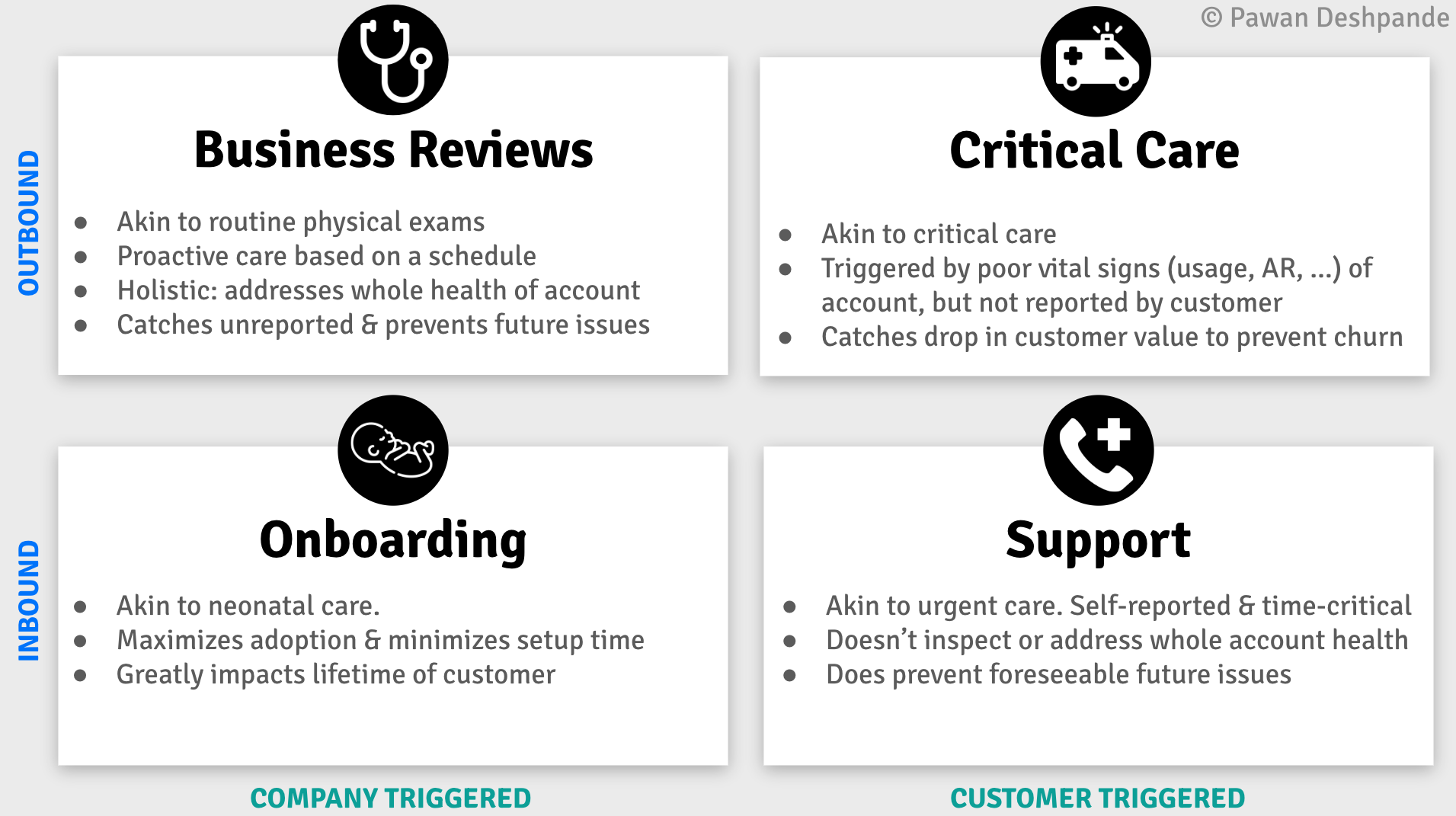
These four means of providing customer success can be categorized across an Outbound versus Inbound dimension as shown on the vertical axis in the diagram above.
- Outbound entails when the vendor or company reaches out to a customer to provide support. In our framework, Business Reviews are outbound because the company / vendor has defined the cadence for when these reviews will be conducted on routine bases. Similarly, Critical Care is outbound because the vendor will reach out to a customer when an issue is detected that warrants outreach to the customer.
- Inbound entails when the company gets an inbound request to initiate a customer success process. In our framework, support is a reactive form of customer success that starts with an inbound request from a customer. Similarly, onboarding starts withs and inbound request initiate by a customer purchasing the vendor's product.
Company Triggered vs Customer Triggered
We can also categorize the means of providing customer success based on how they are triggered:
- Customer triggered are where something that a customer does initiates a customer success process. In the case of support, this would be a customer filling a ticket for example. In the case of critical care, this may be a customer not paying a bill or stopping use of the product.
- Company triggered are where the vendor or company initiates the customer success process. For onboarding, a post-sale handoff from an account executive to customer success representative will initiate this process. For business reviews, a vendor defined cadence will dictate when the reviews are performed.
When Each Form is Applicable
Not all forms of customer success are applicable to every business. In this section, we'll cover how to think about when each form is applicable.
In general, the business economics will determine which forms of customer success are used.
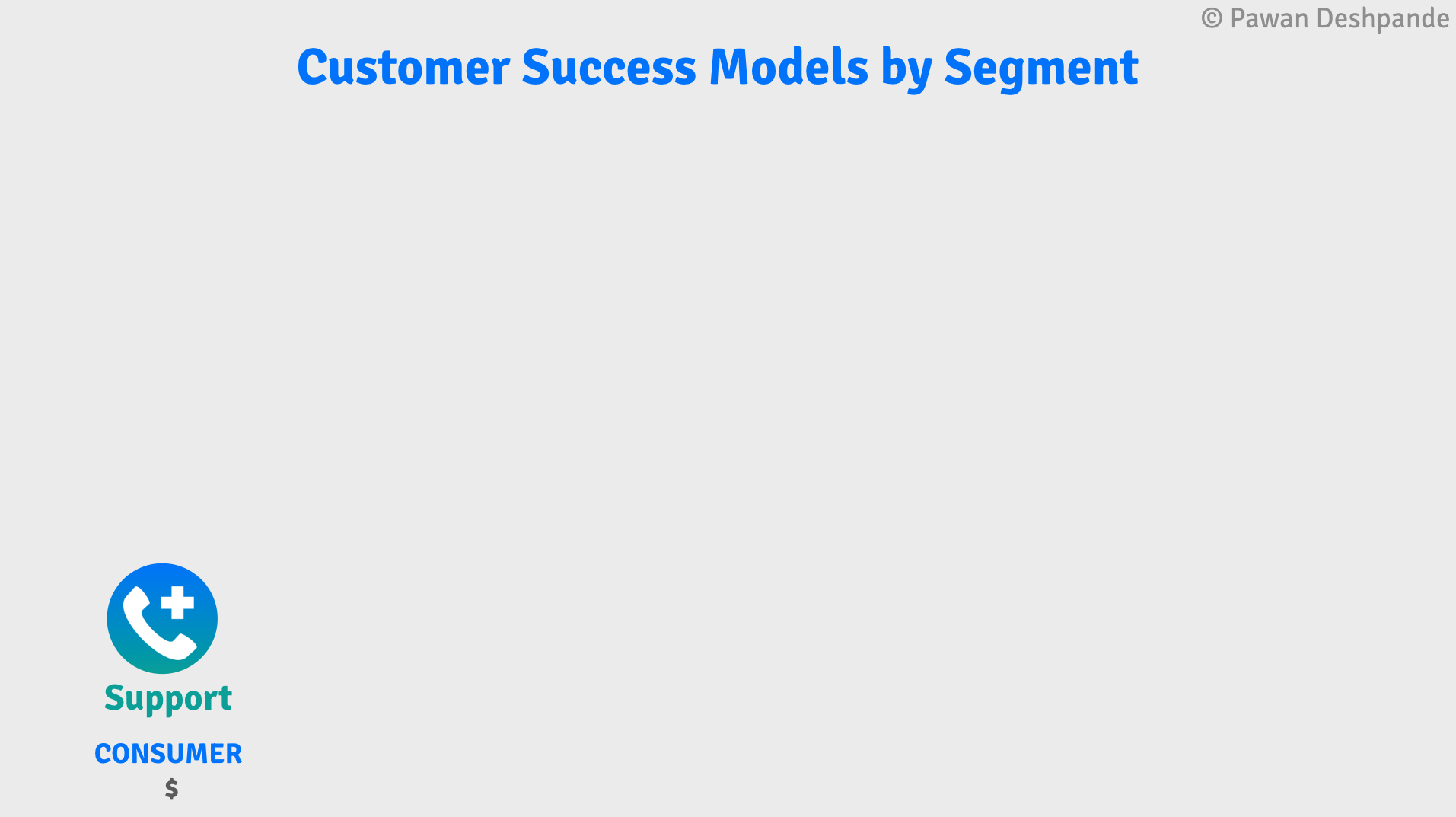
Typically, for consumer businesses, reactive support is often the most that can be offered given the low prices and the low cumulative lifetime value for subscriptions. Meanwhile onboarding, business reviews, and critical care process are either automated, or rendered unnecessary through a simplified product experience.
Let's take Spotify an example which has a low starting price of $5.99 per month for students, and look at how they handle each of these customer success processes:
- Support is available through forums and email, but more expensive phone and in person support are not.
- Onboarding is not needed because their product has been designed to have a simple self-serve experience.
- Business Reviews where typically a customer success representative reviews usage on the account, highlights new capabilities and offerings, and express upsell options is delivered in Spotify through automated email and push notifications. For example, Spotify reviews account usage annually through Spotify Wrapped. And new product capabilities, new music, and upsell offers are delivered through automated notifications.
- Critical care detection and outreach such as a billing issue with a stored credit card are delivered through automated notifications as well.
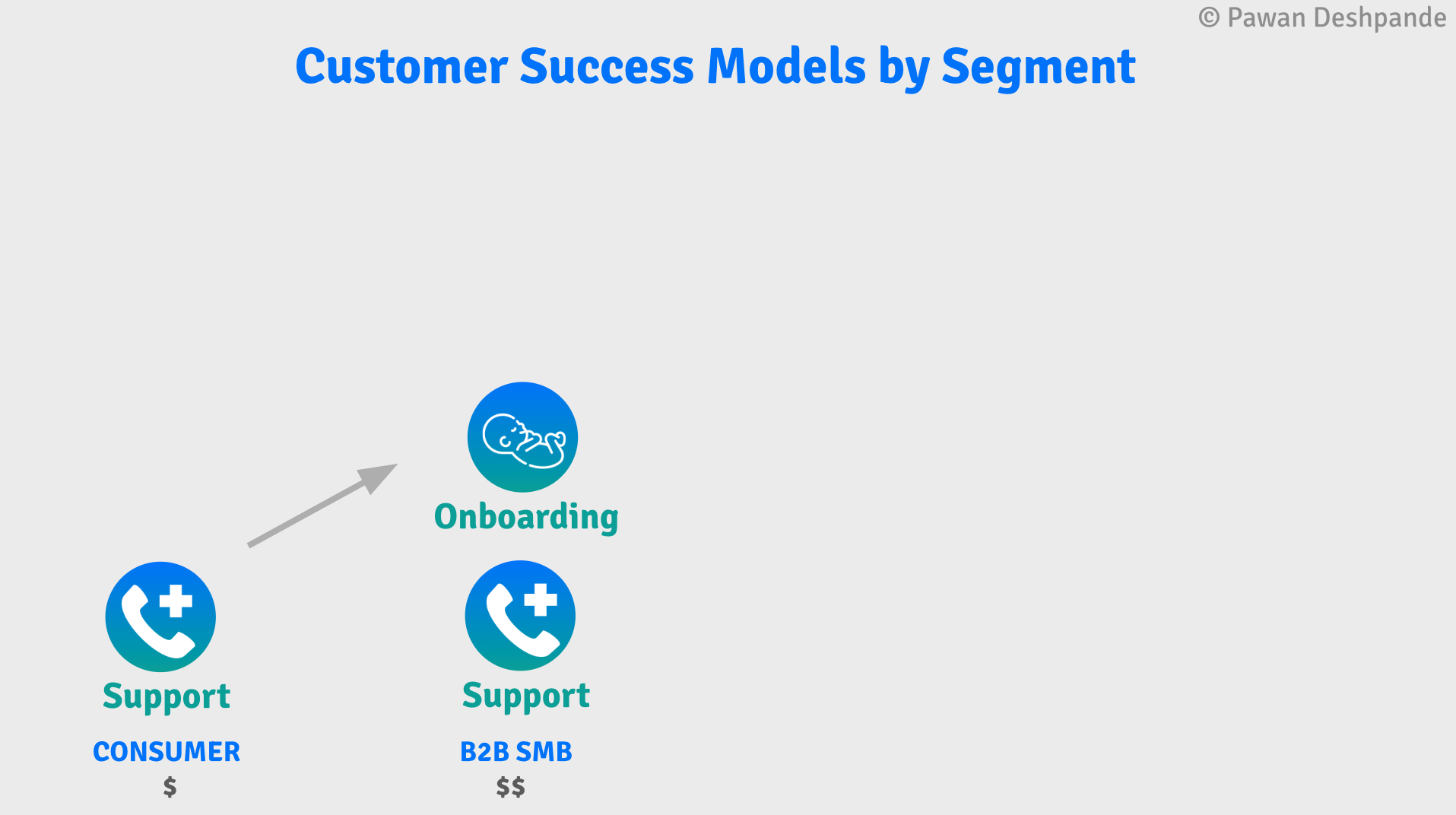
As we move into higher priced segments within SaaS as as B2B companies serving the SMB, customer success is responsible for not only providing support but onboarding as well. But business reviews and critical care remain automated and within the product team's purview.
One classic example of this is Constant Contact, one of the pioneers of email marketing SaaS which predated services like MailChimp.
Not only did Constant Contact provide as needed support, but they also heavily invested in providing handholding through customer success during their onboarding process. The rationale for this was two-fold:
- Their free-trial customer acquisition model had shown that customers who send their first email campaign during the free trial period (who thereby experienced product value) were much more apt to convert to paying customers.
- Their target customer profile was small business owners who often were not technically-skilled enough to self-serve.
But once customers convert to paying customers, customer success only provided support and not business reviews or critical care.
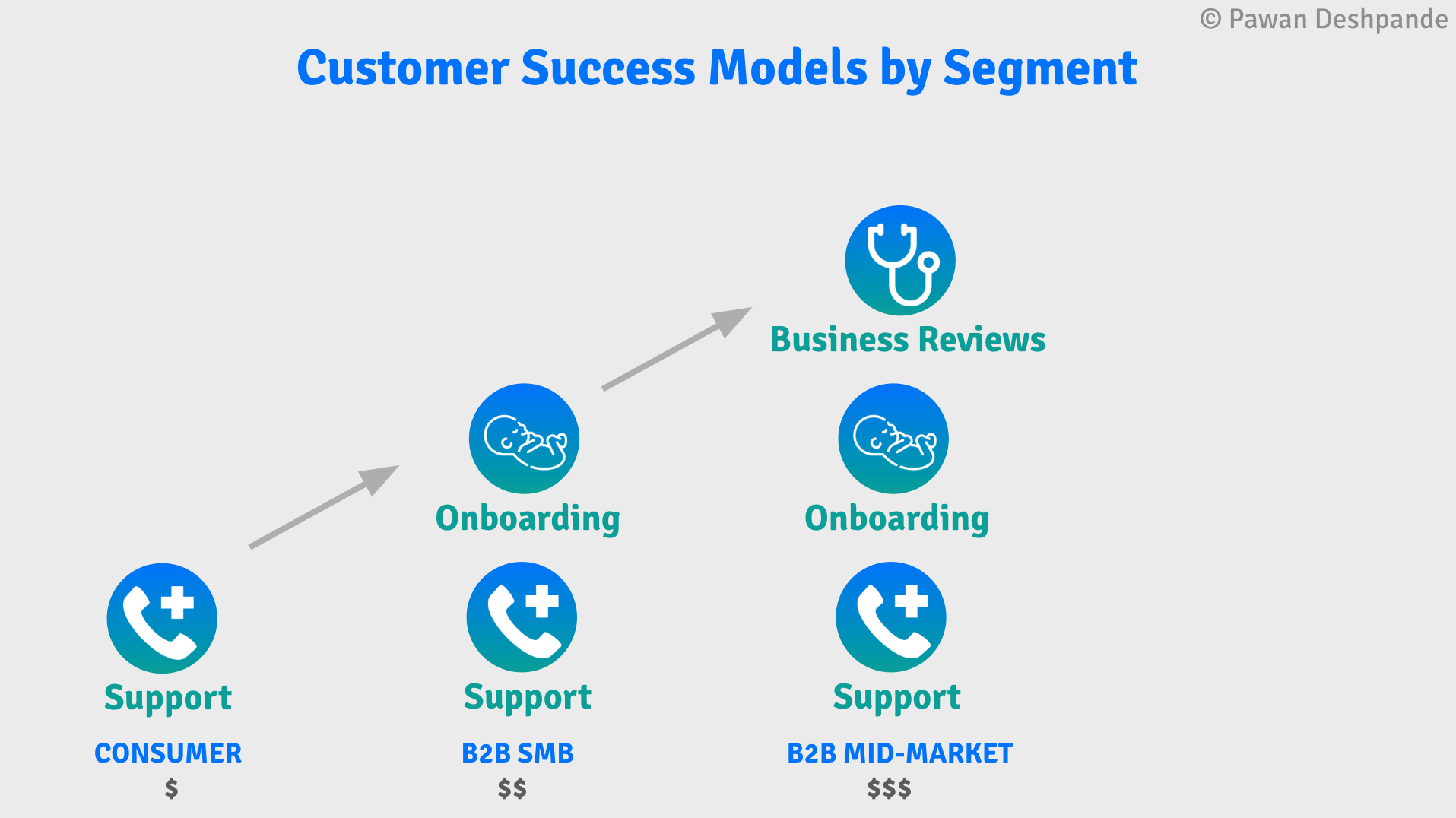
The next step up are where customer success teams perform business reviews on a regular cadence such as on a quarterly basis. The purpose of business reviews is to review a customer's product usage and feature adoption, to ascertain issues that a customer may be facing, gather feedback, share the roadmap, and to upsell or renew customers.
Conducting business reviews take significant customer success time and effort, and therefore only makes sense for products where the lifetime value is high enough to support it. Typically, this is for B2B mid-market to enterprise SaaS products.
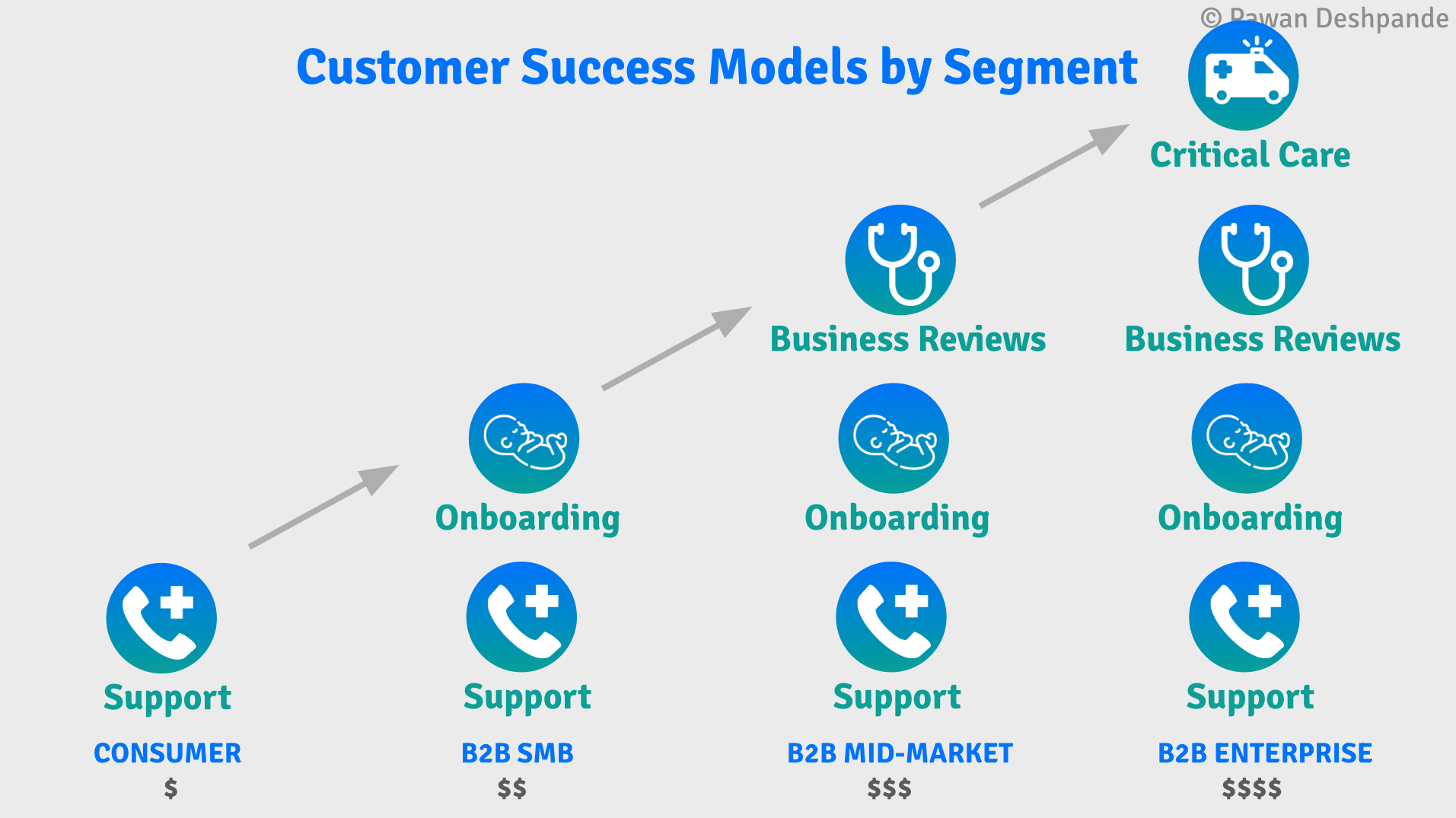
Beyond business reviews is critical care, delivered by customer success teams. Doing so though customer success, rather than solely through automation is expensive because it requires a customer success representative to repeatedly reach out to a customer to revive an account. Given this, critical care is only viable for high ARR accounts.
Critical Care Triggers
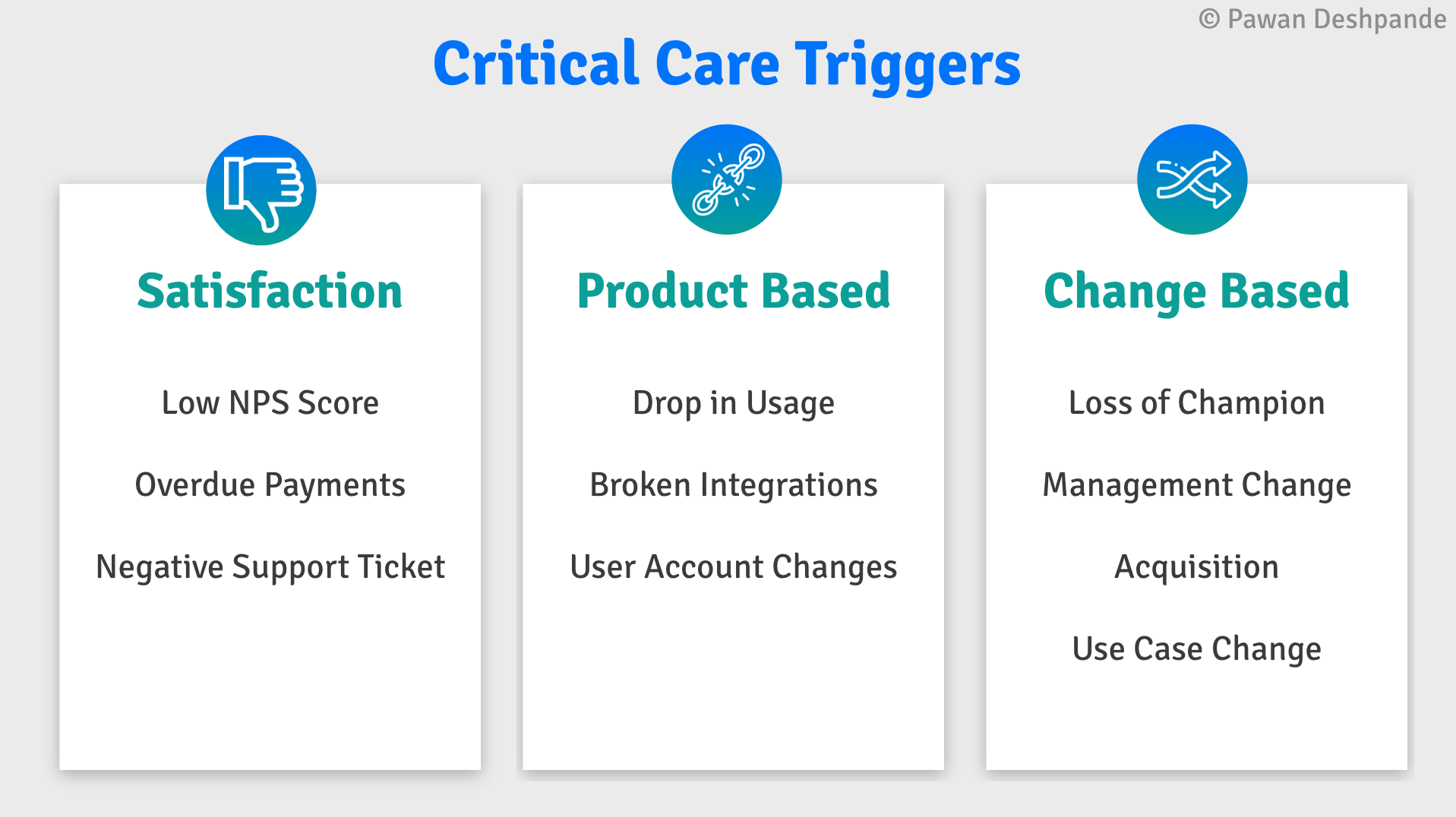
Critical care triggers are used to alert a customer success representative as to when they should attempt to revive an account. They come in three categories: satisfaction, product based, and change based.
Satisfaction Triggers
In the satisfaction category, we are looking for triggers that measure when there is a drop in customer satisfaction. Examples of specific triggers include low NPS (in our case we continuously polled using AskNicely), overdue payments, and negative support tickets.
Product-based Triggers
In the product based category, we are seeking to measure when there is abnormal product usage. Examples of specific triggers include drop in usage, broken integrations, and changes in user accounts such as new or deactivated users. These can be detected through product analytics tools, or custom product dashboards.
Change-based Triggers
In the change based category, we are looking for changes in the customer organization which puts the account at risk. Examples of changes here are the loss of the champion, reorganizations and management changes, an acquisition, or a change in use case. These are often the hardest to measure programmatically, and can be gleaned being in regular touch with the customer, from news headlines, and changes on LinkedIn.
The Four Stages of Critical Care
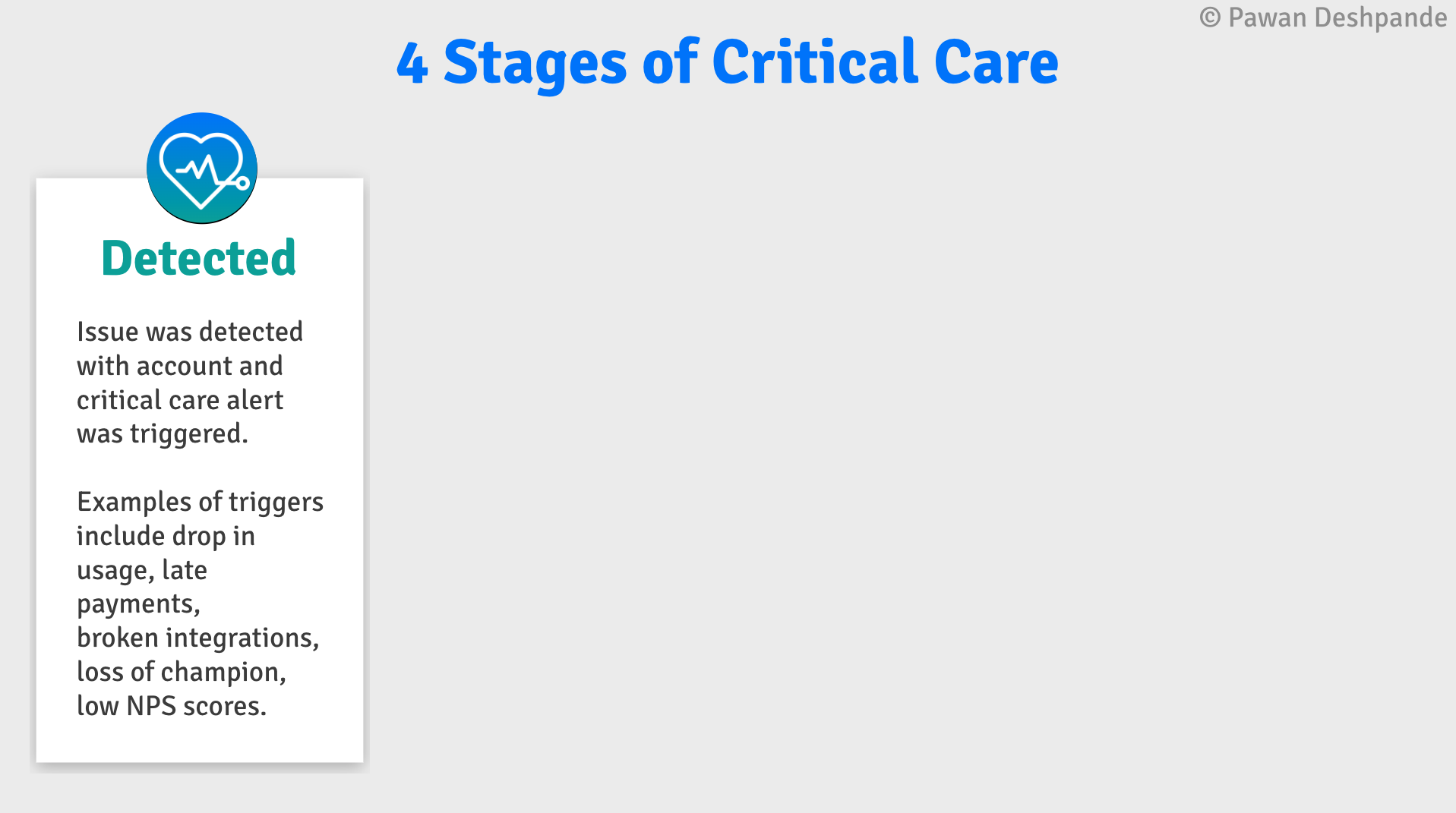
Next, we will explore the four stages of critical care that take place based on the aforementioned triggers.
The first stage is when triggers are detected either through automated means, out manually such as noticing a job change on LinkedIn or learning on a customer call about an impending acquisition.
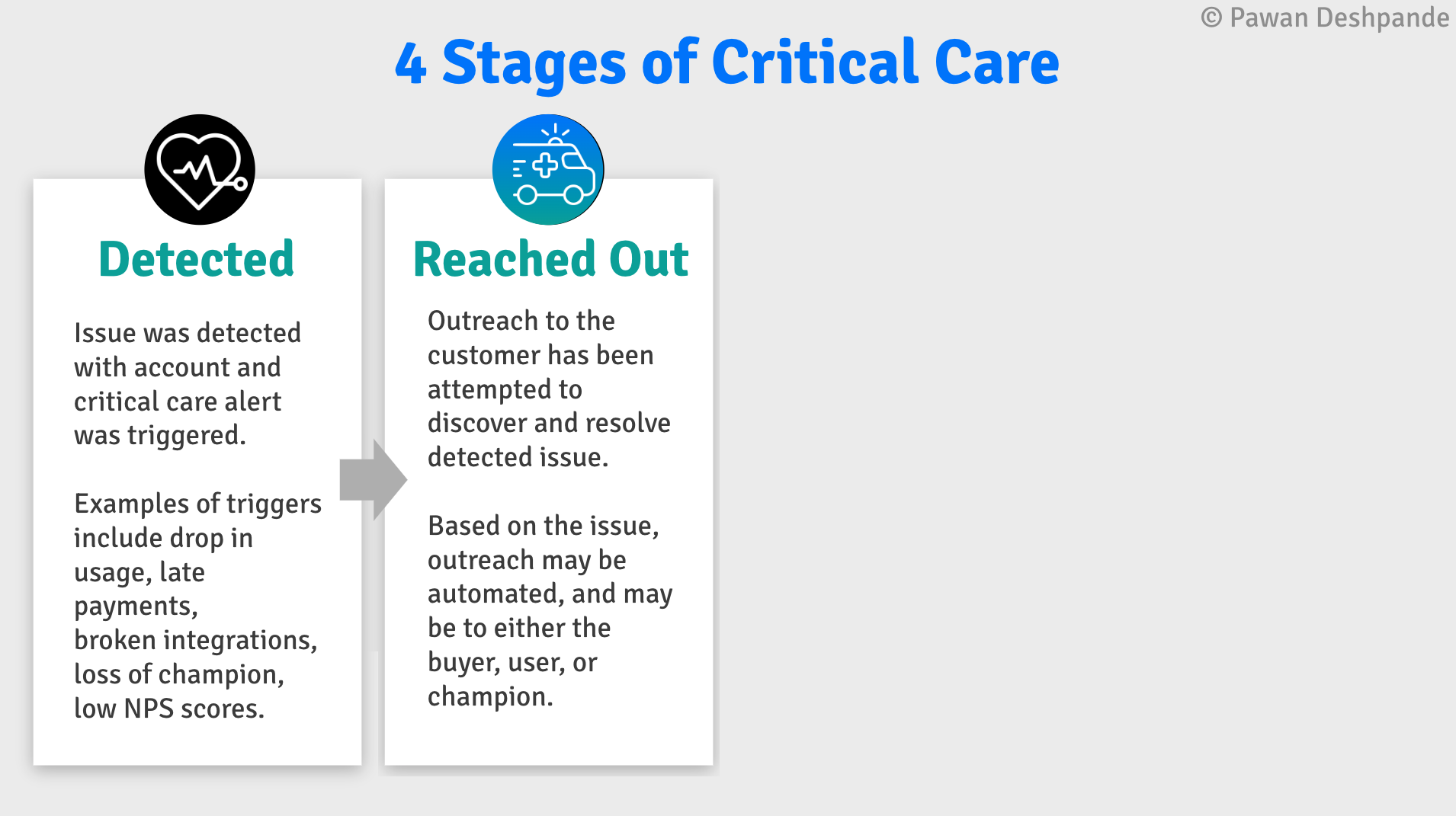
Once a trigger had been detected, the next step is to reach out to the customer in hopes of learning more about the cause of the detected issue, and ultimately resolving it.
For some triggers, the outreach may be instantaneous and automated such as an automated email for a broken integration. However, most outreach will likely be manual in order to have a conversation with the customer to ascertain the underlying cause of the trigger.
This step maybe particularly demotivating for a customer success team. Despite multiple outreach attempts, a customer may continue to be unresponsive. Or if the champion has left the organization, a customer success manager may struggle to find the next best contact to reestablish the relationship. A poor customer success team will blame the customer for the unresponsiveness and resign with futility. A strong customer success team will be creative in finding a way back to the customer, perhaps by partnering with sales or escalating to the executive level.
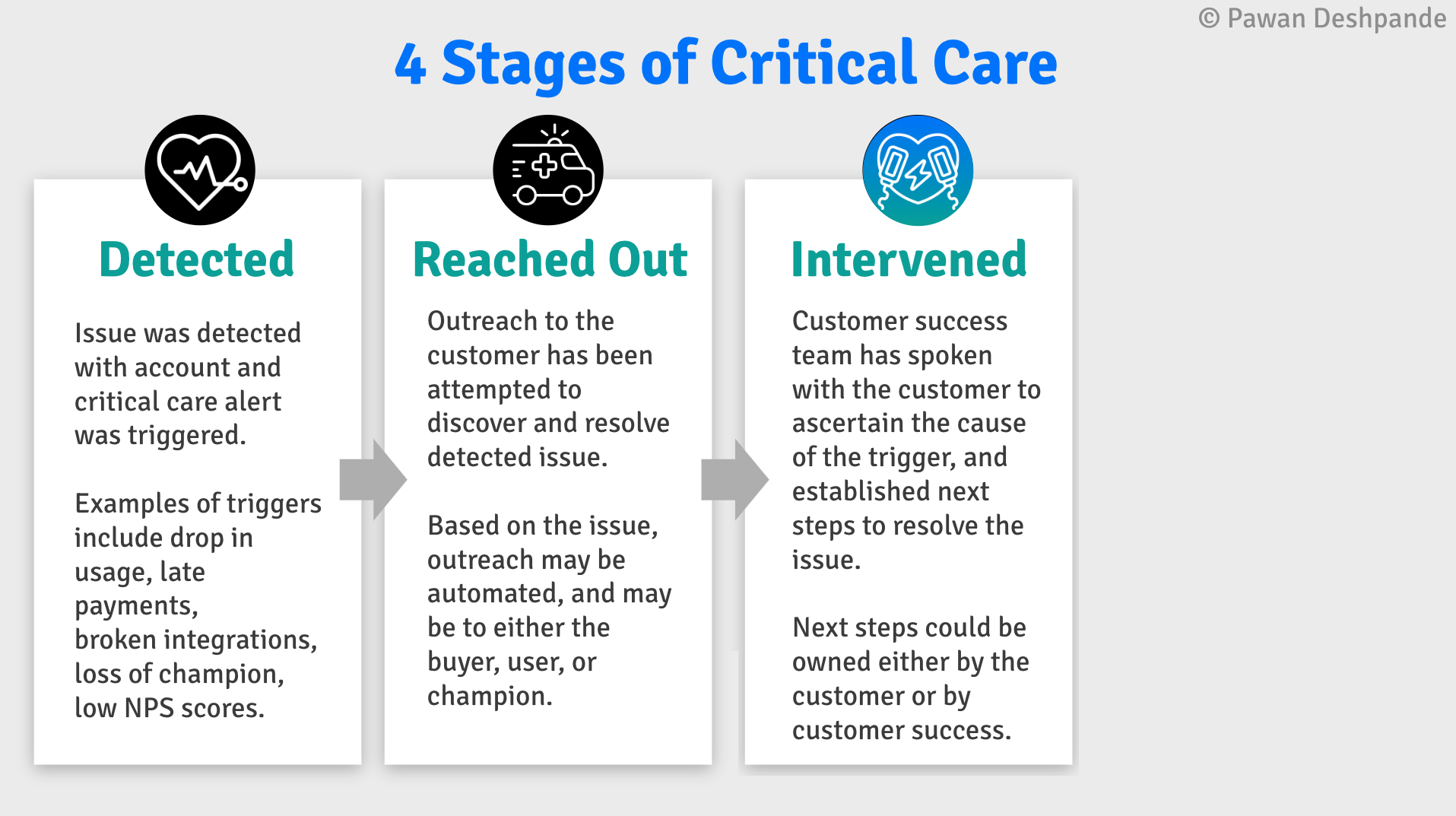
Once the customer has been contacted, the customer success team next is tasked with intervening to discover the underlying issue which caused the trigger to be detected, and then to define what steps need to be taken to ameliorate the situation. Some of these steps will be signed to the customer success team such as fixing a bug out conducting an onboarding session with a new user, while others are assigned to the customer, such as reauthorizing an integration with another system.
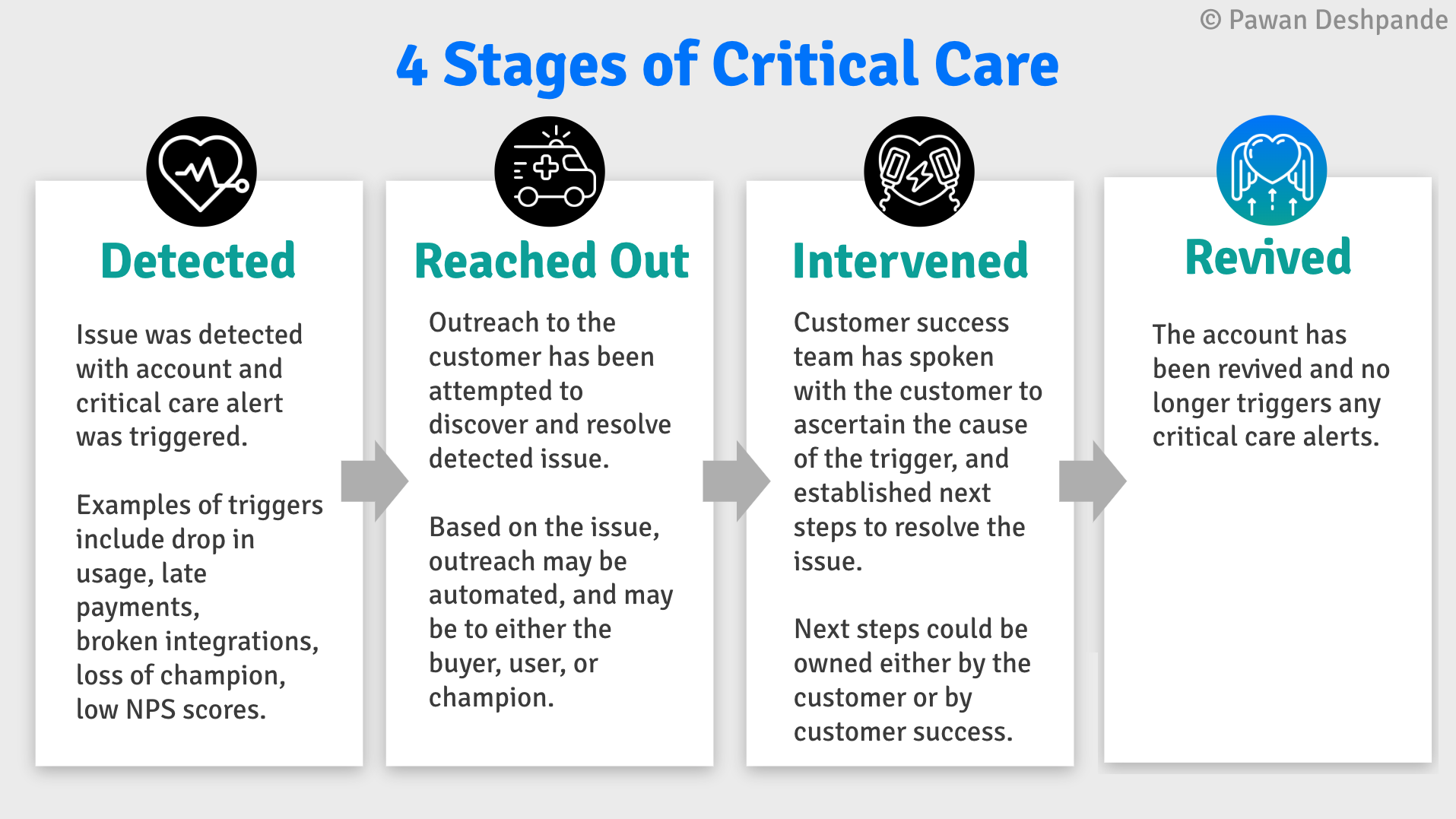
The last step in the process is when the customer is revived, and the trigger can no longer need detected.
The four step process above can be operationalized as a Kanban board, with a daily stand up ritual where each customer success team member add a card for each new customer detected by a trigger, and then moved cards across the board as progress is made. The stand up provides an opportunity for team members to ask for help and escalate issues as well.
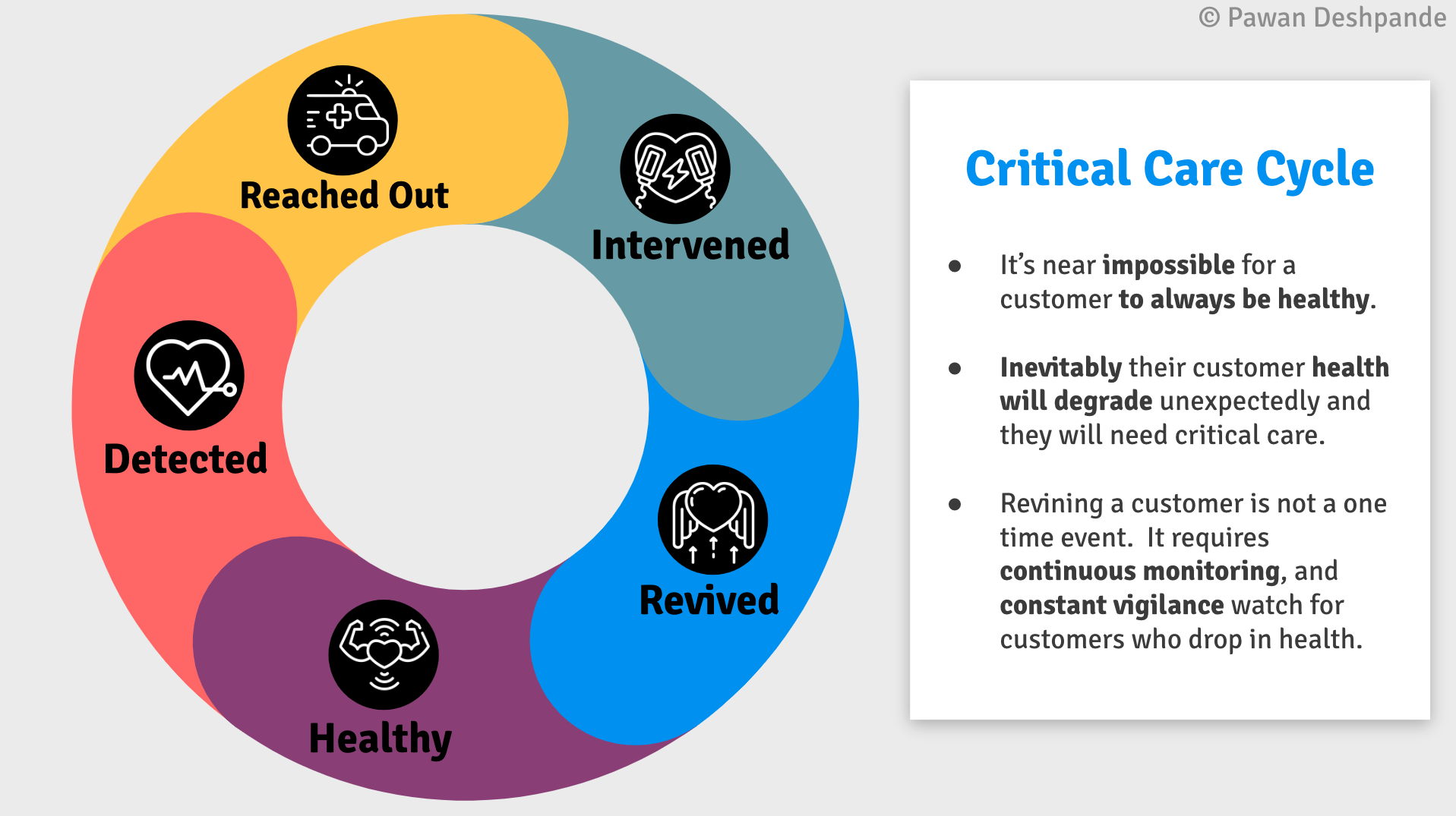
The reality is that it is impossible for a customer to always be healthy. Even the best and most dedicated customers will inevitably degrade and will require critical care. So rather than thinking of critical care as a linear process, we should think of it as a cycle instead.
Next, we will explore the sensitivity of triggers and it's impact on the business.
Trigger Sensitivity
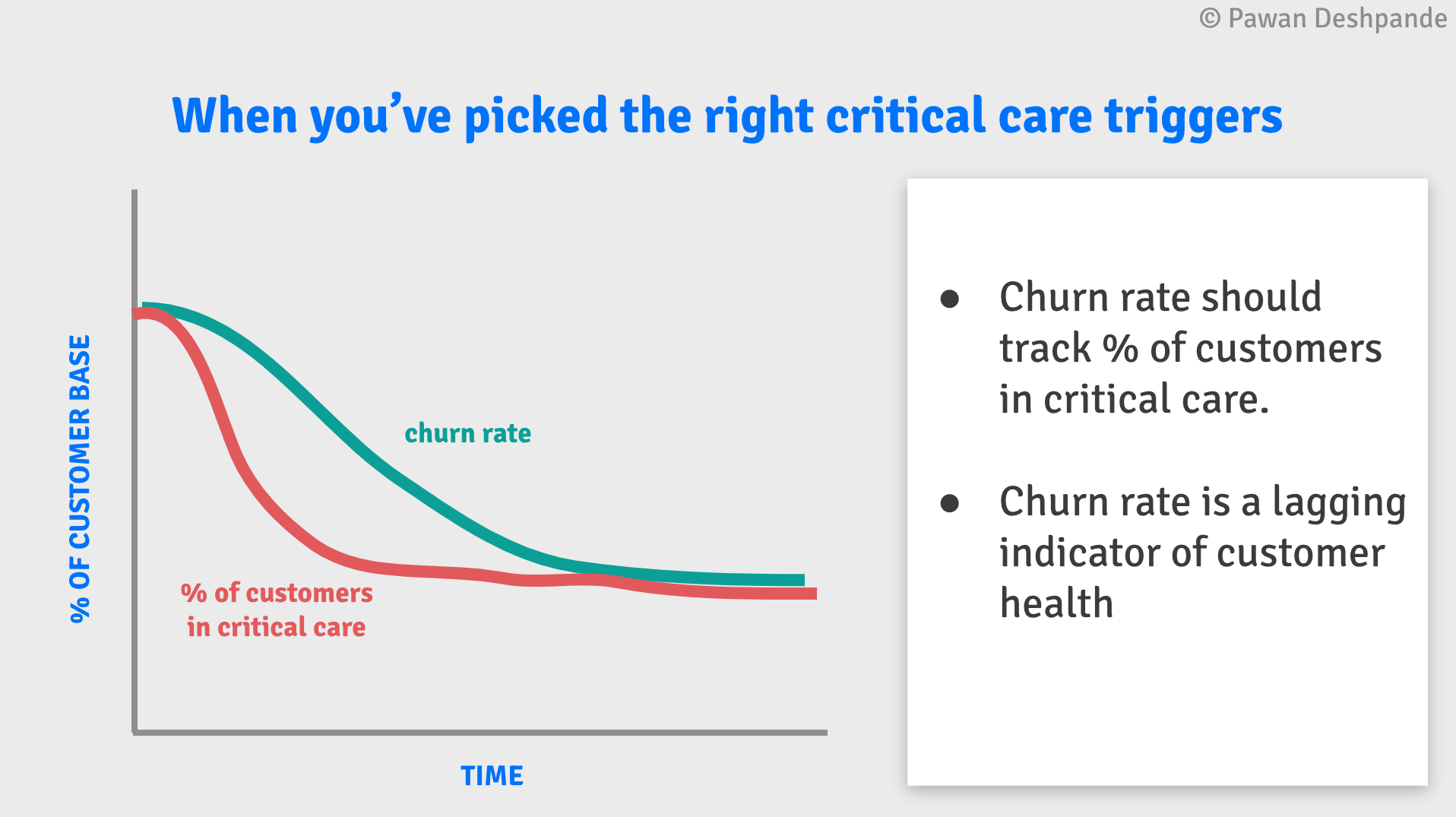
Churn is a lagging indicator of customer health. Often, by the time we find out that a customer will not be renewing, it's too late to revive the about because they have been unhealthy for so long. So instead we use triggers as an actionable early warning detector to gauge when a customer may unhealthy.
When triggers are tuned appropriately, the percentage of customers in critical care should approximately be equal to the churn rate.
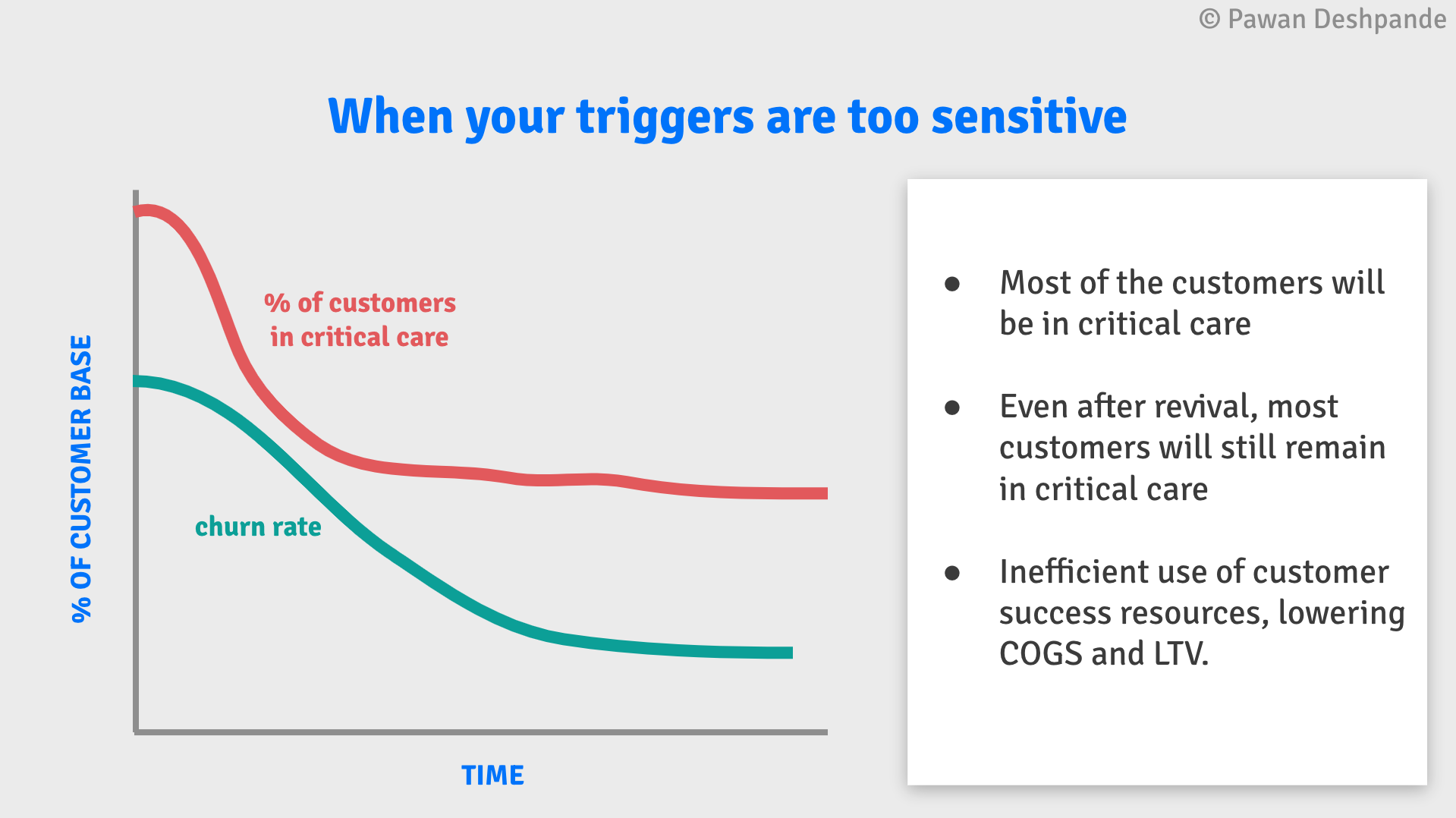
When triggers are too sensitive, most of your customer base will be in critical care even if they are actually healthy. This can happen for example of you place a customer in critical care too soon. Examples of this may be adding customers to critical care if their Even after revival, customers will quickly relapse into critical care.
While it may seem like a good thing to be very attuned to any possible degradation in customer health, there are a few downsides. First, it requires unsustainable level of investment in customer success to have enough resources to constantly reach out to a majority of the account base. Second, the customer success team can become demotivated when they observe that an account they just revived, again in back in critical care. Third, customers can become quickly fatigued and annoyed if they are repeatedly restart to my customer service team when they are actually is no issue with their account on their end.
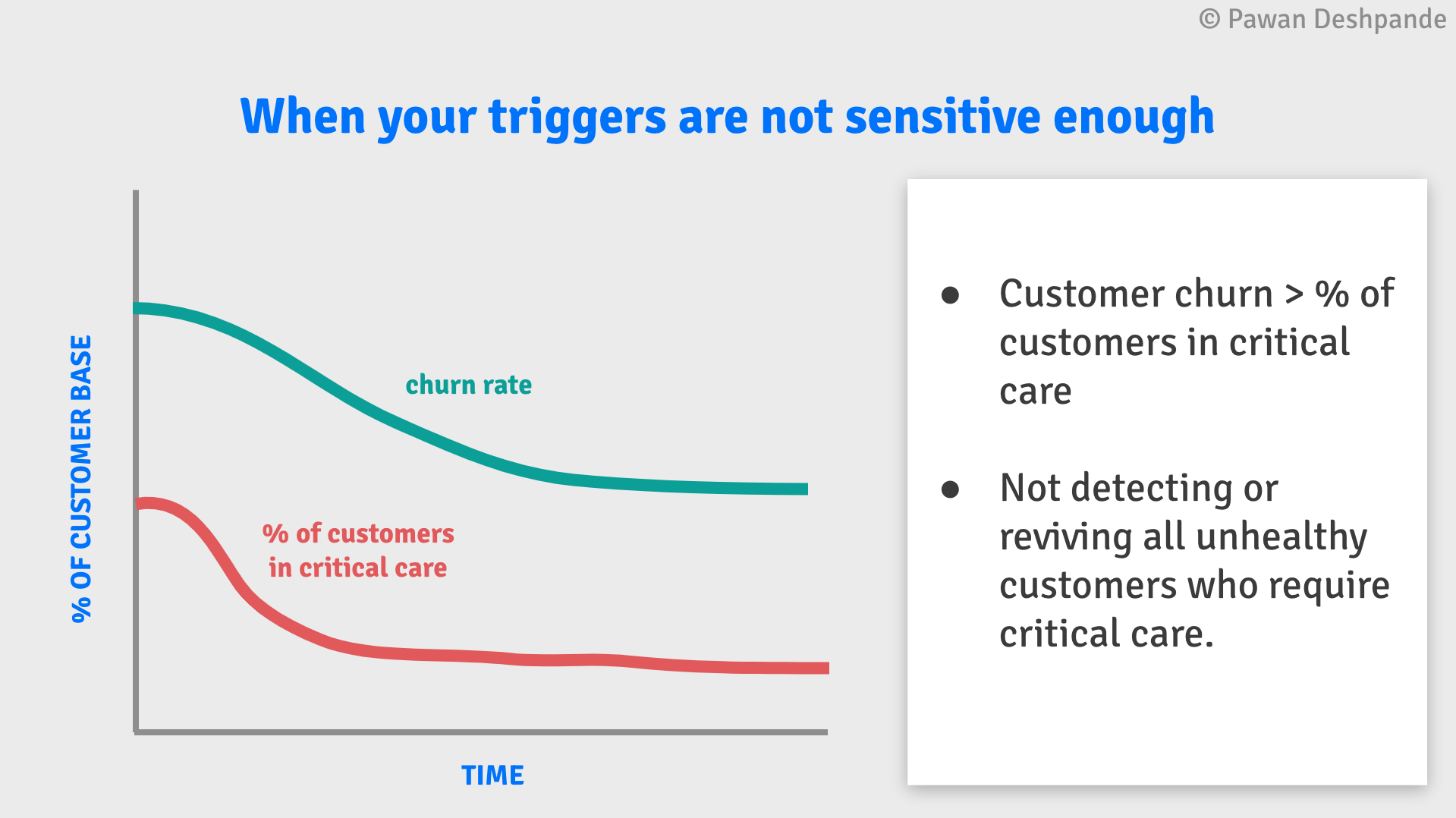
On the other hand, if your triggers are not sensitive enough, then they are not picking up all the potential unhealthy customers. And as a result, many customers will go under the radar or actually unhealthy and will go undressed. Eventually these customers will churn.
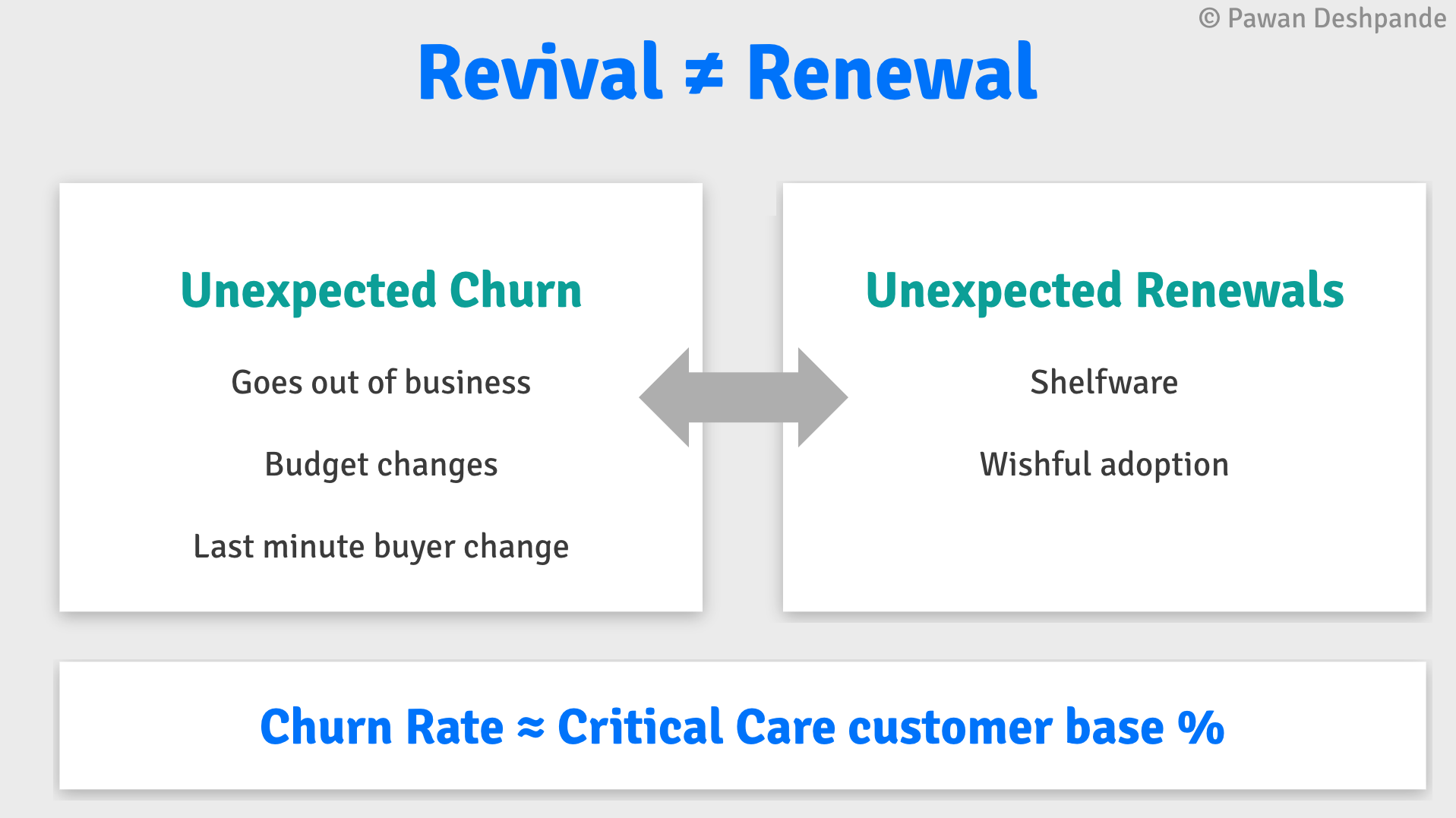
But just because an account is not in critical care, it does not mean that the account will renew per se. Because despite an account being healthy and not flagging any triggers, they're offering unexpected reasons for turn such as a customer going out of business, budget changes, or a last-minute change in the decision maker / buyer.
Similarly, on the upside, just because an account is unhealthy and has been sitting in critical care for a long period of time, that does not mean that the account will not renew. For example, even if an account has no usage, it may still renew and continue to sit as shelfware. Similarly a customer who never adopted a product during the current term, may renew in the hopes of wishful adoption for the subsequent term.
Overall, the unexpected churn and the unexpected renewals will probably cancel each other out. And as previously stated, the churn rate should approximately be equal to the percentage of customers that are in critical care.
Technology Implementation
So how do you actually go about setting up a critical care trigger alerting system?
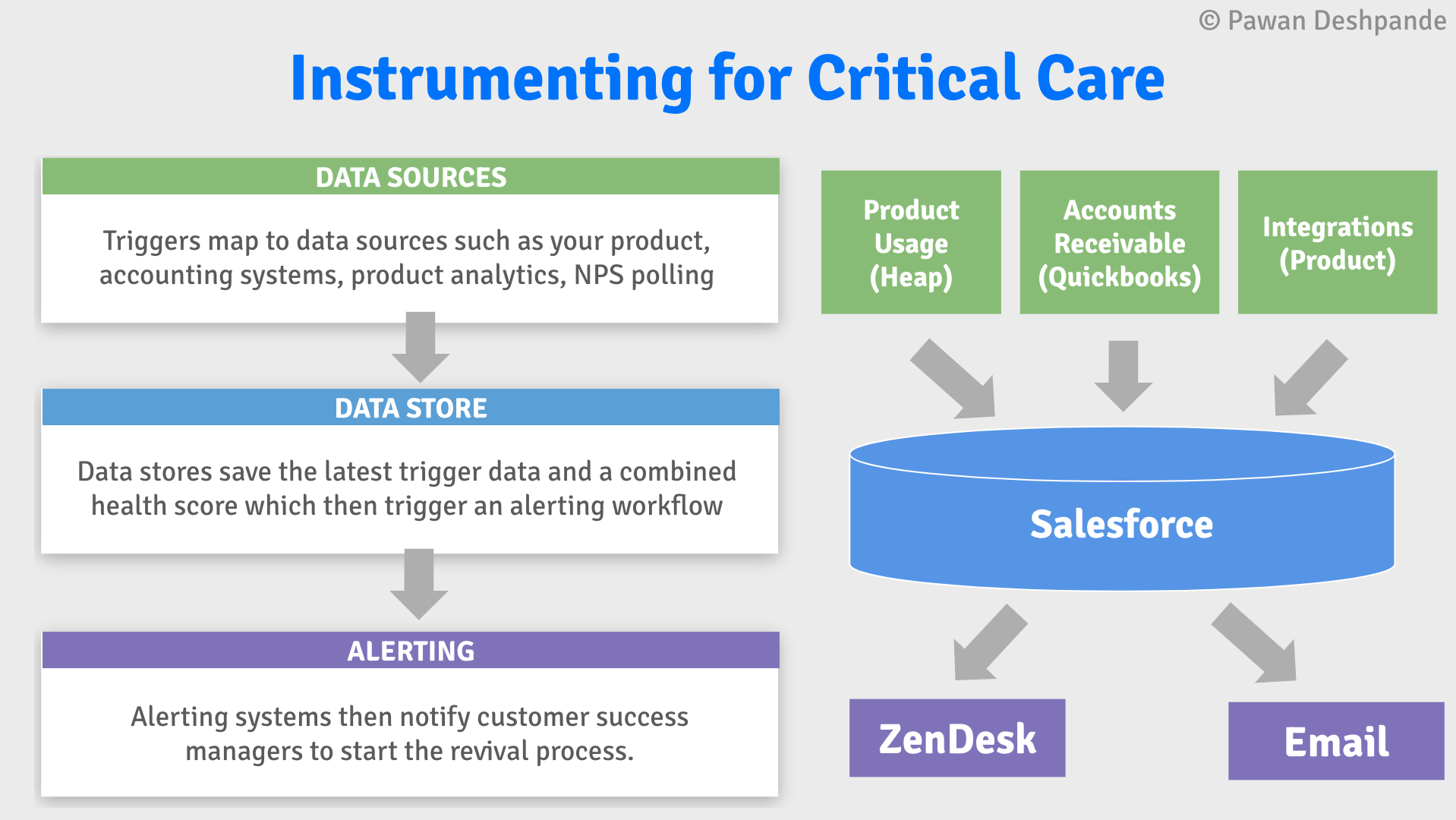
To instrument this, there are three distinct layers: data sources, the data store, and alerting:
Data Sources: The data sources are mapped to the triggers and may include systems such as product analytics, billing systems, and NPS polling for example. In my company's case, we used heap analytics to measure usage, QuickBooks to measure overdue payments, and our actual product to detect broken integrations.
Data Store: The next layer is the data store, which keeps track of which specific triggers have been detected on a per account basis, and in turn computes an aggregate health score for that account. In my company's case, we used the account object in Salesforce to store this information. The data store can also be used to run reports to get an aggregate dashboard view of the health of the customer base.
Alerting: The third layer is alerting. The alerting system reads data such as the health score from the data store and is responsible for alerting the customer success team when an account becomes unhealthy. In my company's case, we would automatically create support tickets in Zendesk, and also send an email alert to the assigned customer success representative for the given account.
Cultural Change
So far we've talked about what needs to be done from a process and technology standpoint to support critical care. But, this also needs to be accompanied with instilling the right culture to make a lasting change.
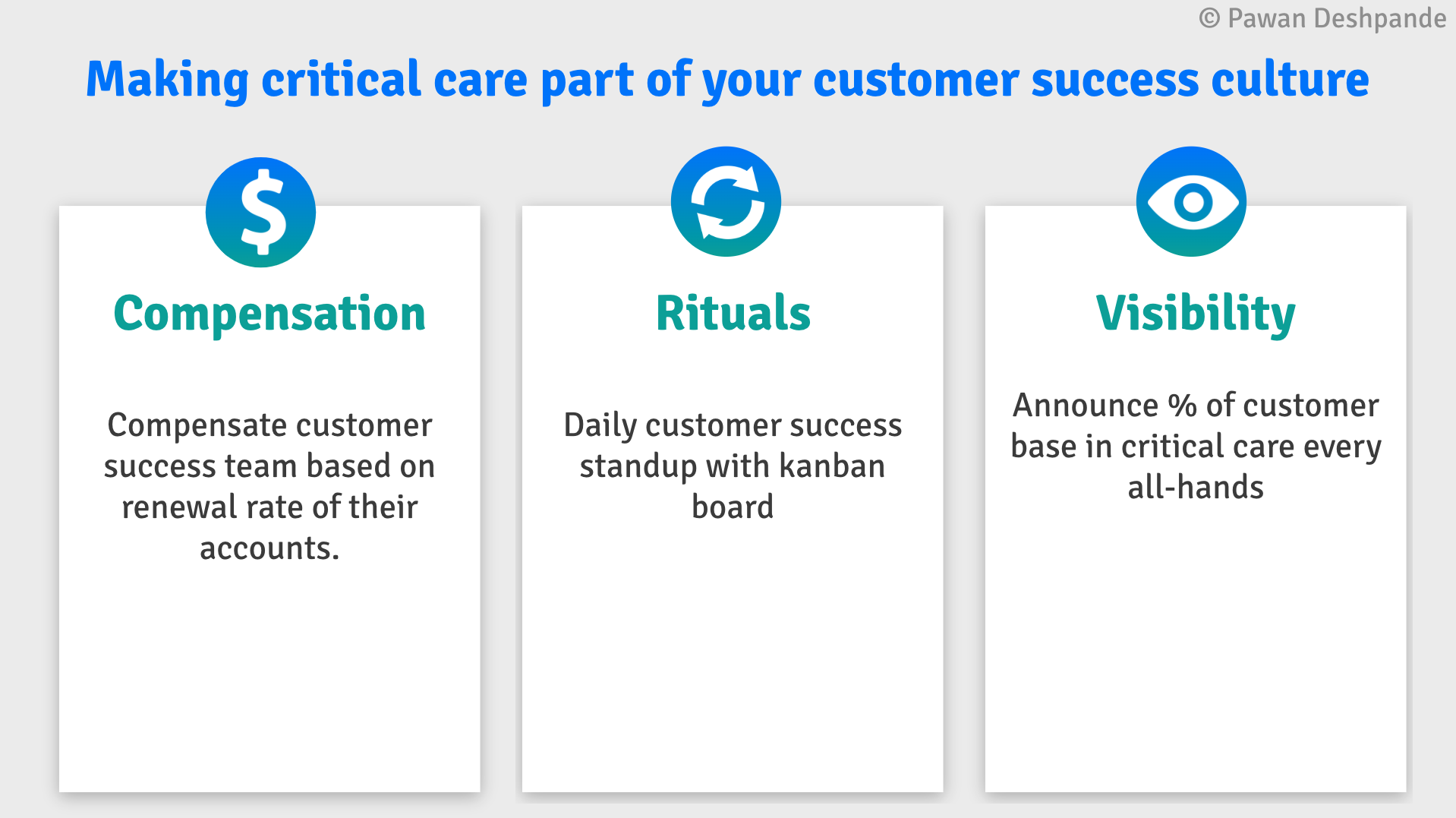
To do so there are three ways of accomplishing this: compensation, rituals, and visibility:
Compensation: The first is to put in place and incentive compensation plan where customer success team members are partly compensated based on the renewal rate of their own accounts. This motivates the team to take ownership over the health of their accounts and adhere to the critical care process.
Rituals: The second is to establish a daily Kanban ritual with the customer success team hat was earlier discussed. Much like how engineering and product teams religiously conduct a daily stand up as a part of agile development, customer success teams practicing critical care should do the same.
Visibility: The third is to increase visibility of critical care. One way of doing this is to announce the percentage of customers in critical care at every all hands meeting. This is a leading indicator of churn so it is crucial employees to know this number to understand the health of the business. It also highlights the importance of critical care to non-customer success functions, which serves as an invitation for them to partake in this team effort as well.
Customer Health Debt
Much like there how engineering teams accumulate technical debt, and product teams accumulate product debt over time. Customer success teams accumulate debt with customer health.
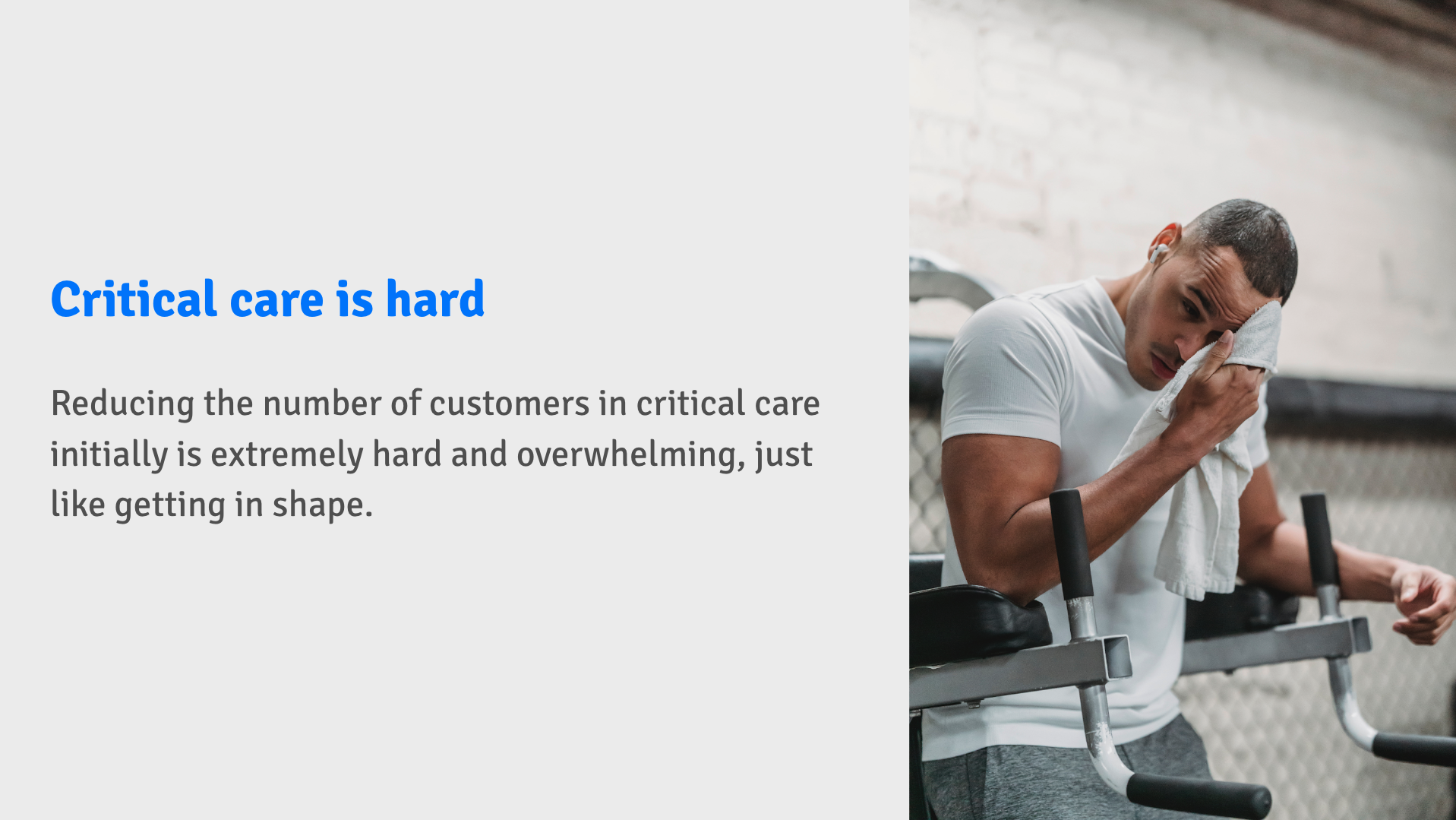
Initially, critical care is very hard because customer success teams will have a backlog of customers to address, similar how getting in shape is initially grueling.
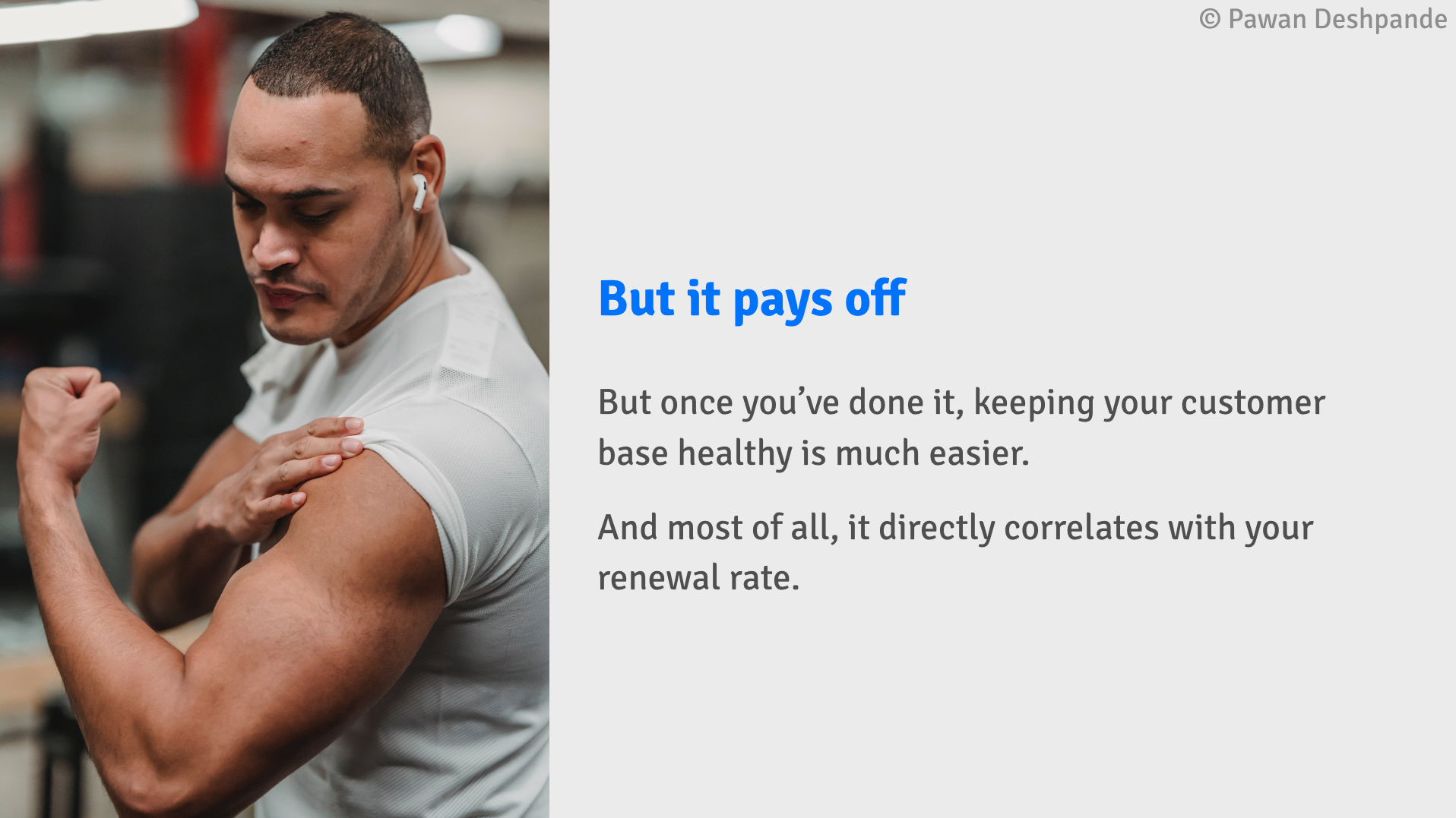
But once the percentage of customers in critical care has stabilized, maintaining that is much easier.
Mindset Change
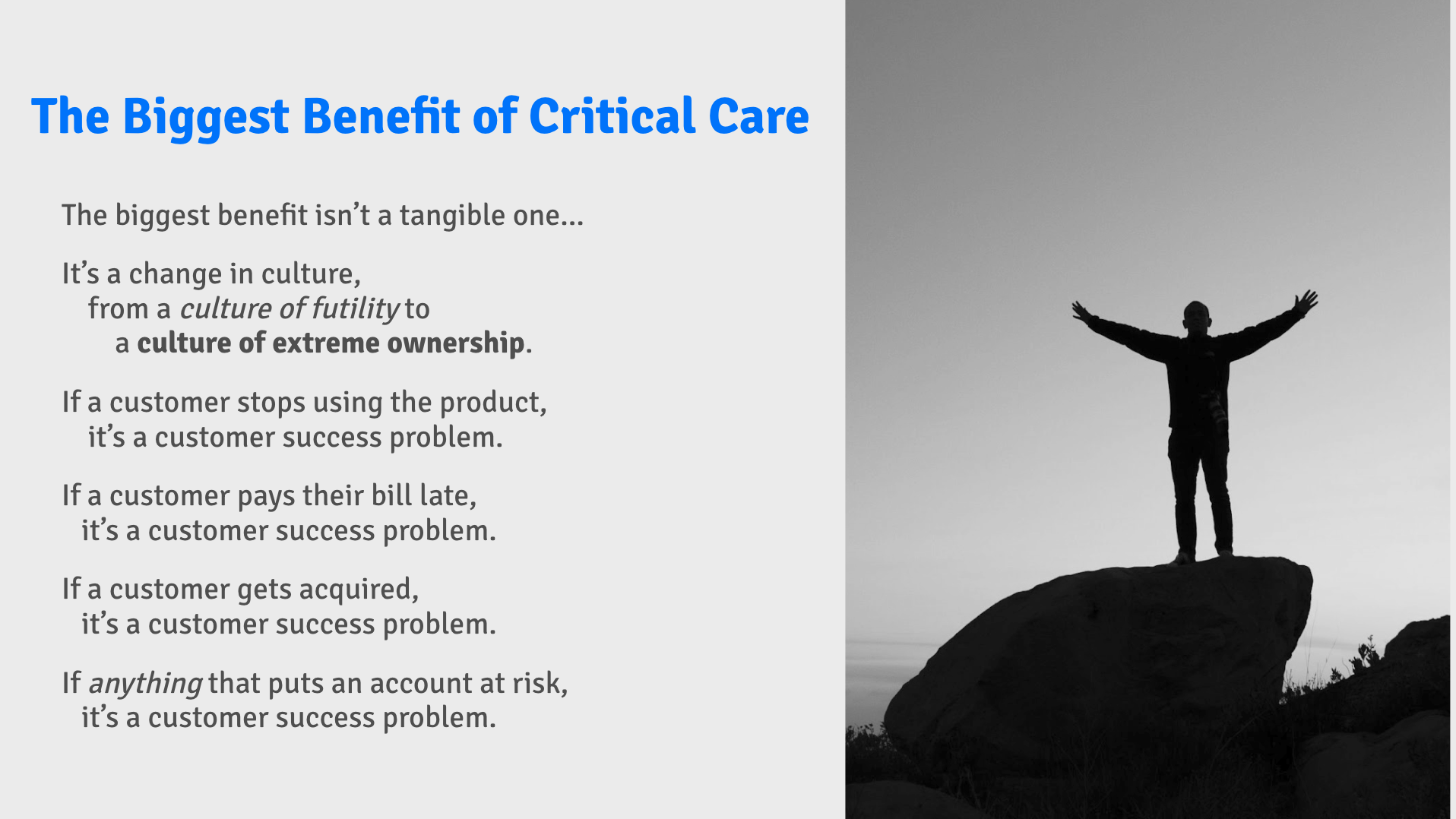
While much what we have covered, relates to the process and practice of critical care, the biggest benefit is actually a change in mentality.
Without critical care, churn off and happens unexpectedly when in fact in many cases it can be prevented for in advance. When this happens over and over again, inadvertently leads to a feeling of learned hopelessness, and specifically an attitude of futility amongst the customer success team.
In a poor customer success organization, a problem with the customer account gets blamed on sales for bringing in a bad customer, product for having a buggy product, or worst the customer for being a difficult customer. But with critical care in place, the customer success team instead takes on an attitude of extreme ownership by building a daily habit of proactively fixing customer issues.
If a customer stops using the product, it's a customer success problem. If a customer pays their bill late, it's a customer success problem. If a customer gets acquired, it's a customer success problem. If anything puts an account at risk, it's a customer success problem at the end of the day. And critical care will help detect the issue, intervene, and ultimately resolve it.
Additional Resources
- Full slides for this framework
- Revenue Builders podcast episode [Apple podcasts]
- Revenue Builders YouTube recording
- Chief Customer Officer Podcast episode
Acknowledgements
This framework came out of many insights gleaned over the years with members of the customer success team at Curata, and our advisory board member Mark Roberge.
Icon credits:
- Doctor icons created by Kiranshastry – Flaticon
- Healthy icons created by Freepik – Flaticon
- Dollar icons created by Gregor Cresnar – Flaticon
- Weakness icons created by amonrat rungreangfangsai – Flaticon