
At one point in my product development career, I discovered something that felt almost unethical. Not better tooling, not agile methodologies, not more rigorous planning processes. I found that the single most effective way to accelerate product development was to manufacture urgency.
Without it, timelines inevitably slip. Decision-making drags on endlessly. Teams overbuild features. Or worse, they build the wrong thing entirely.
What is Manufactured Urgency?
Manufactured urgency is the practice of creating deadlines that feel mission-critical to the team, even when the actual business consequences of missing them are less severe than they appear.
I create a deadline anchored to something real:
- A customer demo… even if that customer is unlikely to convert
- A board meeting… even if the board doesn't really need to see the product yet
- A trade show… even if the demo won't make a material impact on sales
The event itself is real. The calendar date is immovable. But the importance of that specific milestone is intentionally inflated.
To the team, it becomes a must-hit deadline. And that changes everything.
Why Manufactured Urgency Works
In the absence of urgency, product teams default to their natural behaviors:
- Scope creep – "While we're at it, we should also build..."
- Analysis paralysis – Endless debates about the perfect solution
- Gold-plating – Over-engineering features that customers don't need
- Misalignment – Different team members pulling in different directions
But introduce a hard deadline tied to a real event, and suddenly:
- The team ruthlessly cuts scope to what's essential
- Decisions get made quickly because there's no time for endless deliberation
- Everyone aligns around the same goal
- The team actually ships
The deadline forces trade-offs. And trade-offs force clarity.
The Anatomy of an Effective Manufactured Deadline
Not all manufactured deadlines are created equal. The most effective ones share three characteristics:
1. Tied to a Real Event
The deadline must be anchored to something that actually exists on the calendar. A conference that's been scheduled. A customer meeting that's been confirmed. A board meeting that's on the books.
This prevents the deadline from being negotiable. You can't reschedule a trade show. The customer has already blocked their calendar. The board is expecting to see something.
2. Has External Visibility
The deadline needs to be visible beyond just the product team. When other people in the organization know about the commitment, it creates accountability.
If it's just the product team working toward an arbitrary internal deadline, that deadline will slip. But if the CEO has told a customer to expect a demo, if marketing has promoted the trade show booth, if the board has the meeting on their calendar – now there's real social pressure to deliver.
3. Feels High-Stakes (Even If It Isn't)
This is where the "manufacturing" comes in. The team needs to believe that missing this deadline would be catastrophic.
The reality might be that the customer demo is with a prospect who's unlikely to convert. The board meeting might not be the right forum to showcase this particular feature. The trade show might not move the needle on pipeline.
But the team doesn't need to know that. What they need to know is: we committed to this, people are counting on us, and we need to deliver.
When Manufactured Urgency Backfires
Like any tool, manufactured urgency can be misused.
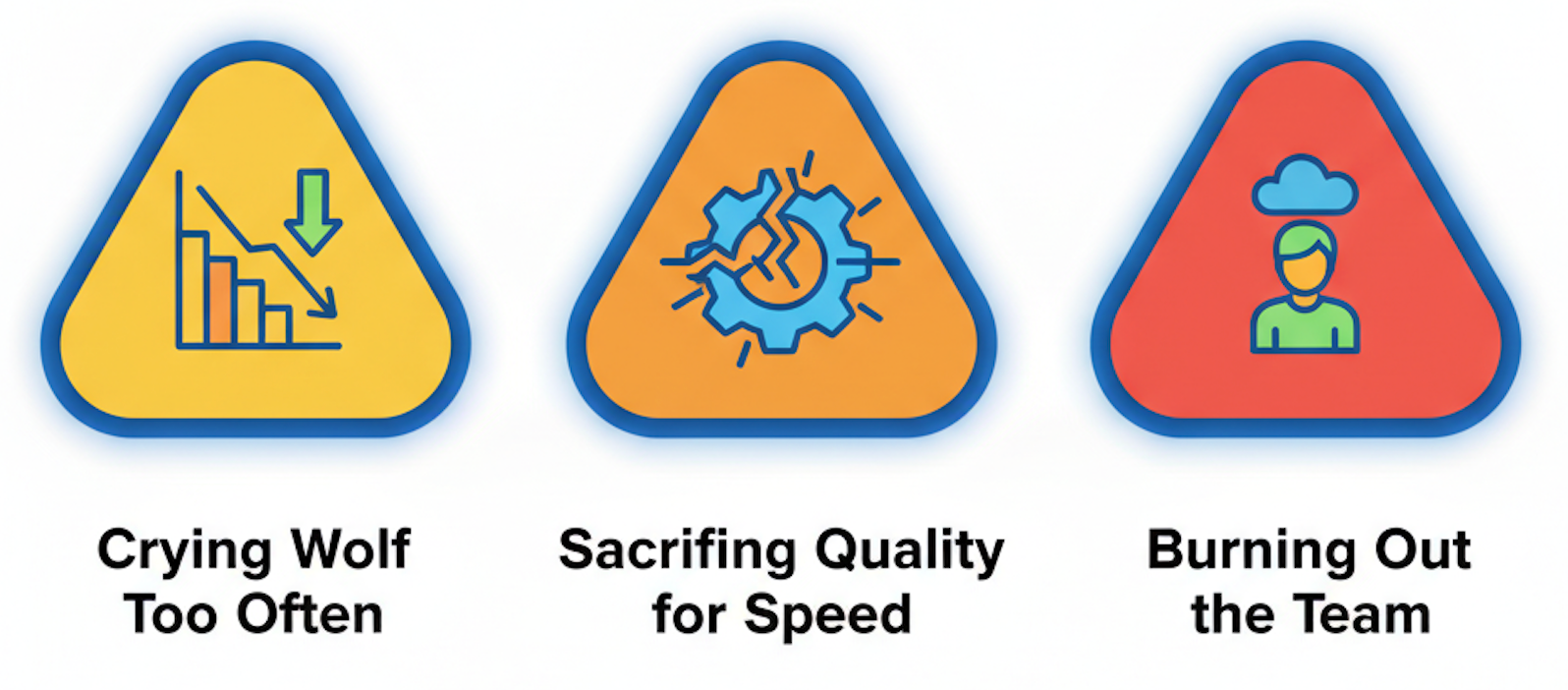
There are three failure modes to watch for:
Crying Wolf Too Often
If every deadline is framed as mission-critical, and the team repeatedly discovers that missing those deadlines had minimal consequences, they stop believing you.
The solution is to vary the intensity. Not every deadline needs to be an all-hands-on-deck fire drill. Save the manufactured urgency for when you really need to compress timelines.
Sacrificing Quality for Speed
Artificial deadlines can push teams to cut corners in ways that create technical debt or ship genuinely broken products.
The antidote is to be ruthless about scope, not quality. Cut features, not craft. Ship less, ship it right.
Burning Out the Team
A constant state of manufactured crisis is unsustainable. If the team is always in crunch mode, they'll burn out.
Use manufactured urgency as a sprint, not a marathon. After a push to hit a deadline, give the team time to catch their breath, pay down technical debt, and work at a sustainable pace.
The Alternative is Worse
The critics of manufactured urgency often argue for a more measured, sustainable approach to product development. "Just let the team work at their natural pace," they say. "Good products take time."
In theory, that sounds reasonable. In practice, it's a recipe for mediocrity.
Without urgency, velocity fades. Timelines stretch indefinitely. The team loses momentum. The product ships late, if it ships at all.
And in fast-moving markets, late is often worse than imperfect.
I'd rather ship a tight, focused product on time than a bloated, over-engineered product that's six months late. The market rewards speed and iteration, not perfection.
How to Implement Manufactured Urgency
If you want to try this approach, here's how to get started:
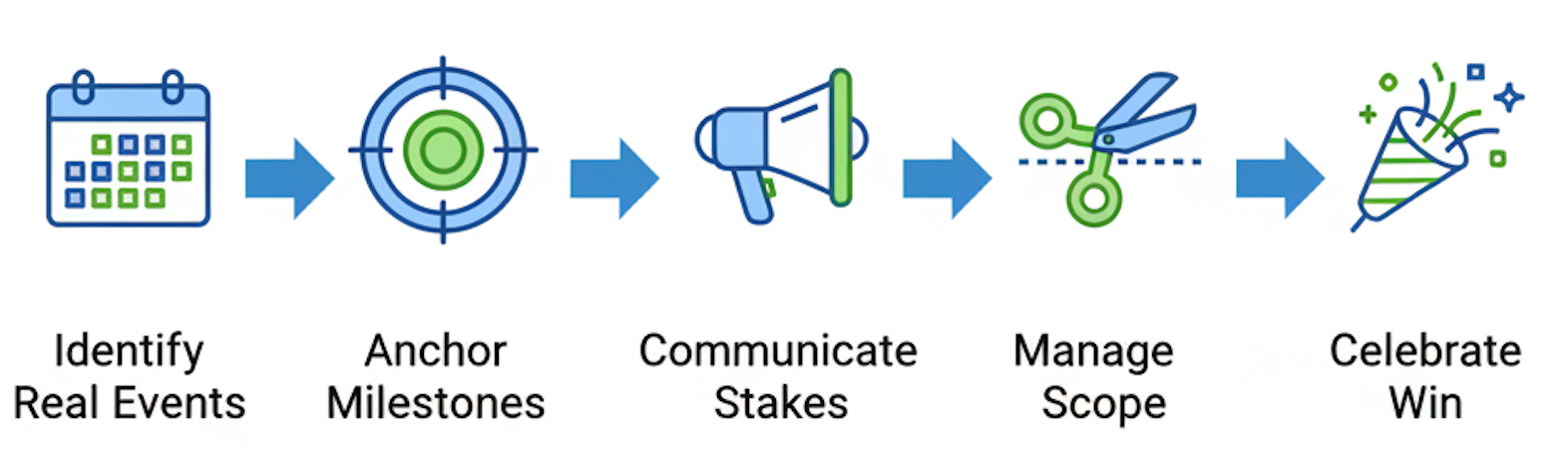
Step 1: Identify Real Events on the Calendar
Look at your calendar for the next three to six months. What events are coming up that could serve as natural deadlines?
- Customer meetings or demos
- Conference appearances or trade shows
- Board meetings or investor updates
- Internal all-hands meetings
- Partner integrations or co-marketing launches
Step 2: Anchor Product Milestones to Those Events
Take your product roadmap and map features to these calendar events. Which feature would make the most sense to demo at that customer meeting? Which capability would be most impressive to show the board?
Don't force fit – the connection needs to be plausible. But you have more flexibility here than you think.
Step 3: Communicate the Stakes
Once you've anchored a milestone to an event, communicate it to the team in a way that emphasizes the importance.
"We have a demo with [Customer Name] on [Date]. This is a major opportunity for us. We need to show them [Feature] working end-to-end."
You're not lying. The demo is real. The opportunity exists. You're just... emphasizing it.
Step 4: Ruthlessly Manage Scope
Once the deadline is set, your job is to be the scope cop. Every feature request, every "nice to have," every "while we're at it" gets evaluated against the deadline.
If it's not essential to hitting the milestone, it doesn't make the cut. End of discussion.
Step 5: Celebrate the Win
When the team hits the deadline, celebrate publicly. This reinforces that these deadlines matter and that the team's effort was worthwhile.
And after the celebration, give them a break. Let them work on tech debt, refactoring, or lower-priority features at a more relaxed pace.
The Uncomfortable Truth
Manufacturing urgency feels manipulative. And in a sense, it is.
You're creating artificial pressure to drive behavior. You're inflating the importance of deadlines that might not be as critical as you're making them seem.
But the alternative of letting product development drift along at whatever pace feels comfortable is worse for everyone. Worse for the team, who lose momentum and pride in shipping. Worse for the company, which falls behind competitors. Worse for customers, who have to wait longer for the products they need.
Sometimes the kindest thing you can do for a team is to give them something urgent to rally around.
Because without urgency, nothing ships. And a product that doesn't ship helps no one.